
I’m not sure what’s worse…
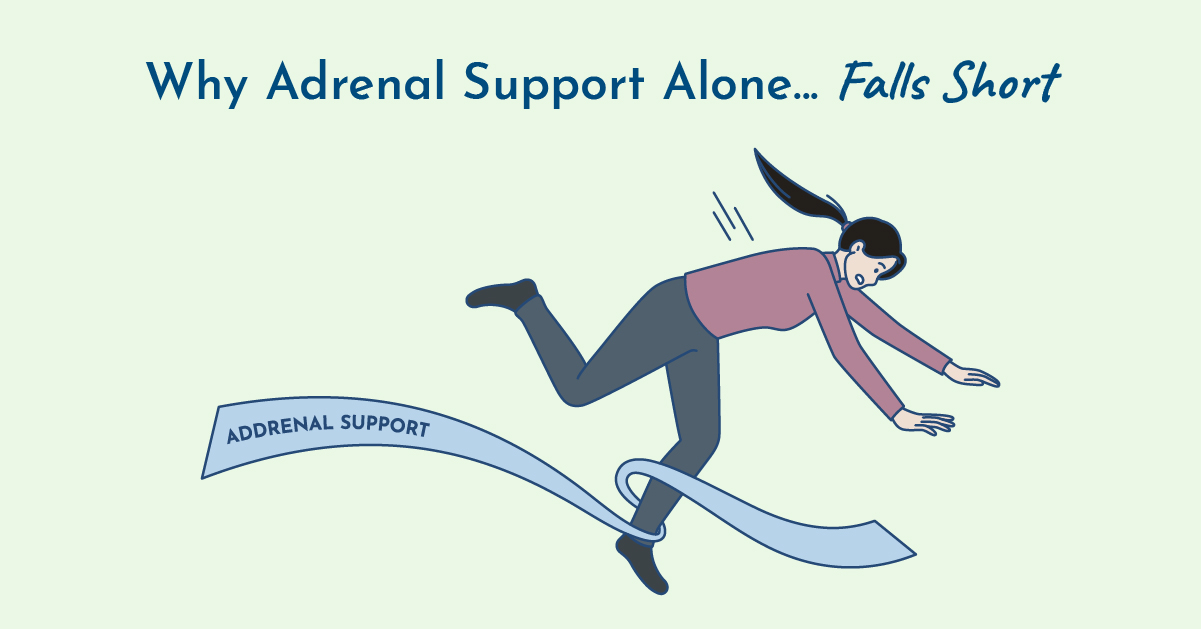
A) The fact that “adrenal fatigue” has become the default explanation for why so many people feel exhausted, wired, anxious, or unable to sleep.
OR
B) The fact that many of the most common recommendations aimed at adrenal fatigue actually increase stress on the body — while quietly working against your thyroid in the process.
That’s right.
Here’s the part that surprises most people…
Your adrenal glands don’t actually “fatigue” in the way the term is commonly used.
That doesn’t mean your symptoms aren’t real.
They are.
But the explanation you’ve been given is incomplete — and in many cases, it’s pointing you in the wrong direction.

Because while adrenal glands are remarkably resilient and designed to adapt under stress, what does change is how much demand your body places on them.
And that demand is often driven by something most adrenal conversations barely mention…
Your thyroid.
Once upon a time, we followed the same conventional thinking.
Adrenal testing was routine.
Adrenal-support supplements were standard.
Special diets were recommended.
Labs were rechecked every few months.
And improvement?
It was inconsistent at best.
Sometimes cortisol numbers barely moved. Sometimes they got worse.

It wasn’t until a different pattern became clear — one tied to thyroid function and metabolic demand — that things finally started to make sense.
Once that clicked, everything changed.
Here’s the Problem No One Explains
“Adrenal fatigue” sounds logical.
You feel tired.
You feel stressed.
So your stress glands must be tired… right?
Here’s the problem…
That’s not how human physiology actually works.
The adrenal glands are designed to respond to stress — not collapse under it.
What changes instead is how often your body has to rely on stress hormones to get through the day.
And when that reliance becomes constant, symptoms start to pile up.
This is where most explanations stop short.
Why Your Thyroid Is Often the Real Bottleneck
We see this pattern all the time.
People dealing with persistent thyroid symptoms — low energy, cold sensitivity, brain fog, poor sleep — are often told their cortisol is “off.”

And yes, cortisol patterns can change.
But here’s what rarely gets explained…
Thyroid hormone helps regulate the metabolic conditions that allow adrenal hormones like cortisol to be produced and sustained.
In other words, lower cortisol often shows up alongside low thyroid function — not because the adrenals failed, but because the system doesn’t have the metabolic capacity it needs.
So instead of asking, “How do I stimulate my adrenals?”
A better question is…
“Why doesn’t my body have the metabolic capacity it needs to keep stress hormones balanced?”
The Thyroid-Adrenal Stress Cycle (This Is Where Things Get Stuck)
When thyroid-driven energy production slows, the body doesn’t just give up.
It compensates.
First, it leans more heavily on stress hormones to keep blood sugar stable, maintain alertness, and get you through the day.
That works — temporarily.
But higher stress signaling interferes with how efficiently thyroid hormone is converted and used throughout the body.
So demand goes up…
Efficiency goes down…
And the system gets stuck.
Here’s what that looks like beneath the surface:
- Lower thyroid efficiency increases stress demand
- Higher stress signaling suppresses thyroid hormone activity
- Over time, the body relies more on adrenaline when cortisol can’t keep up
This is what we call the Thyroid–Adrenal Stress Cycle.
And this is where many of the symptoms blamed on “adrenal fatigue” actually come from…
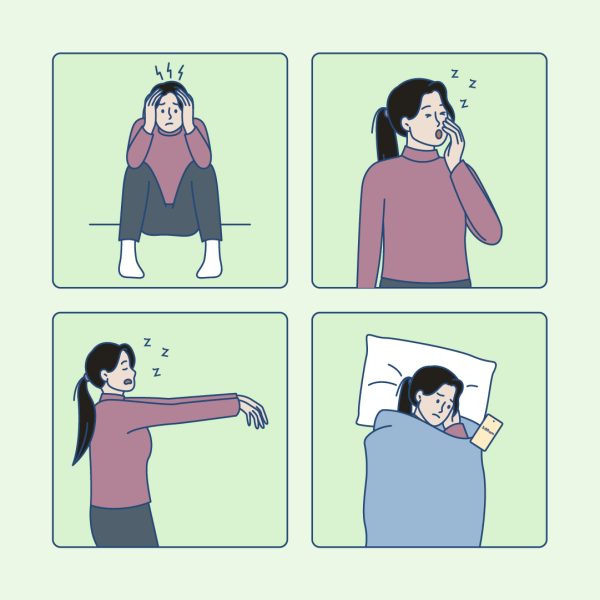
Racing thoughts.
Wired-but-tired energy.
Trouble sleeping — but crashing when you finally rest.
Feeling like your body never fully powers down.
Not because your adrenals are broken — but because your body is running on emergency backup power.
Why Common “Adrenal Support” Can Backfire on Your Thyroid Health
Here’s where good intentions often cause problems.
Most adrenal protocols focus on two things:
- Replacing or stimulating cortisol
- Aggressively controlling blood sugar with low-carb diets
The problem?
Neither approach reduces the underlying demand.
In fact, some of them increase it.
For example…
Very low-carbohydrate, high-protein diets are often recommended to “stabilize blood sugar.”
But protein alone actually lowers blood sugar.
So what does the body do?
It releases more stress hormones to compensate.
In other words…
You feel supported temporarily — but the thyroid-stress cycle stays intact.
And over time, thyroid symptoms quietly worsen.
The Real Goal with Supporting Your Adrenals
The goal is not to “fix” your adrenals.
The goal is to lower unnecessary stress demand while restoring metabolic efficiency.
When you do that, the adrenals stop being overworked on their own.
Here’s how we approach it.
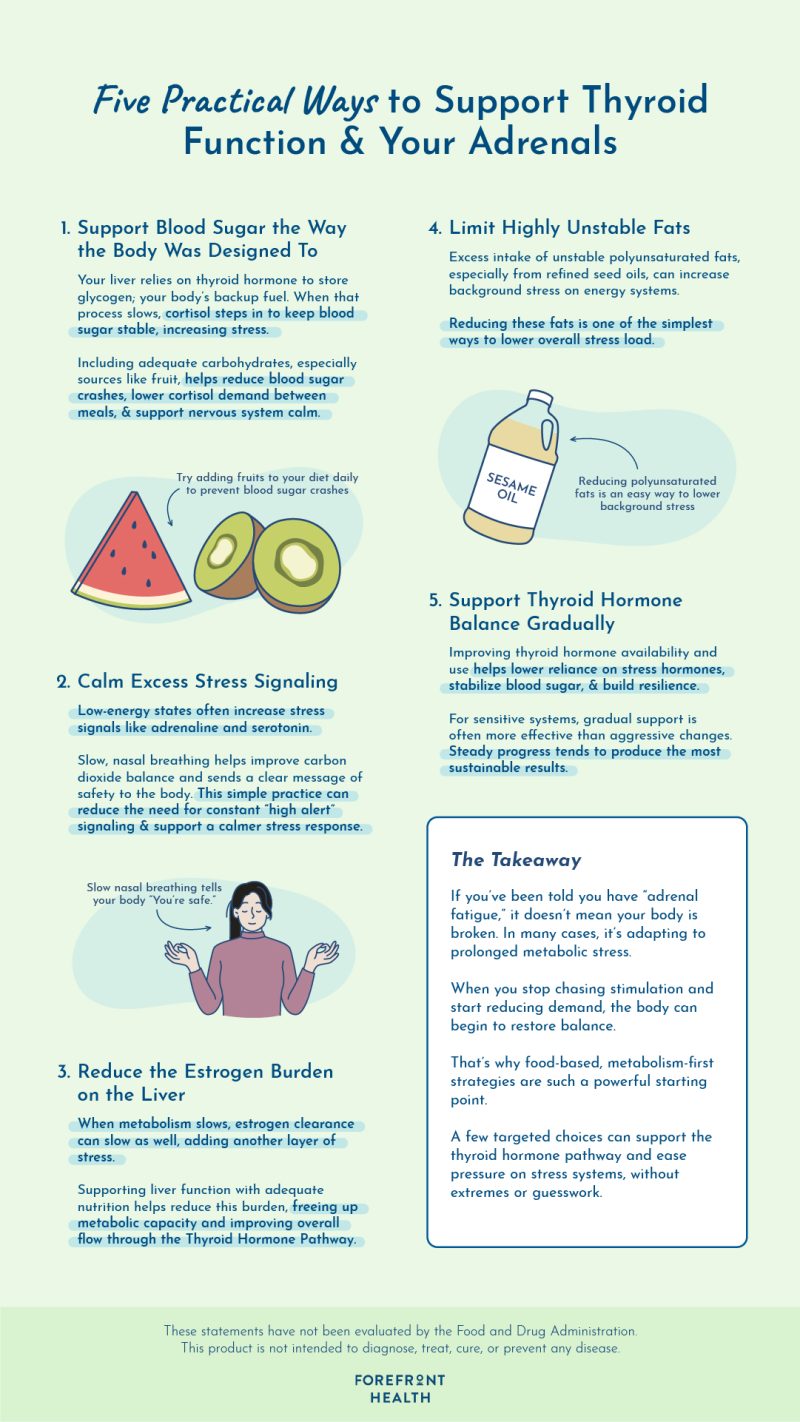
5 Practical Ways to Support Thyroid Function AND Your Adrenals
These aren’t extreme hacks.
They’re foundational levers.
The goal is to support a proper balance within the Thyroid–Adrenal Stress Cycle.
Small changes — big payoff.
1. Support Blood Sugar the Way the Body Was Designed To
Your liver uses thyroid hormone to store glycogen — your backup fuel supply.
When that process slows, your body relies on cortisol to keep blood sugar stable.
That’s stressful.
Including adequate carbohydrates — especially easily metabolized sources like fruit — helps:

- Prevent blood sugar crashes
- Reduce cortisol demand between meals
- Give your nervous system a break
(Note: This is something we teach in our 3 Food Triple-Thyroid-Boosting Daily Protocol.)

Less emergency signaling… more stability.
2. Calm Excess Stress Signaling
Low-energy states tend to increase stress signals like serotonin and adrenaline.
One simple way to counter this?
Support efficient breathing and carbon dioxide production.
Remember when breathing into a paper bag was commonly used to help calm one in a state of excess stress?
It’s the same principle.
Slow nasal breathing sounds simple — because it is.
But it sends a powerful message to the body:
“You’re safe. You don’t need to stay on high alert.”

3. Reduce the Estrogen Burden on the Liver
When metabolism slows, estrogen clearance often slows with it.
That creates another layer of stress signaling.
Supporting liver function with adequate nutrition — and simple tools like raw carrot fiber — helps reduce this burden and frees up metabolic capacity.
(Note: I show you exactly how to use raw carrot to do this in this article on “How to Support Your Thyroid in 60-Seconds with a Carrot”.)
Less congestion… more flow.
4. Limit Highly Unstable Fats
Certain fats are more likely to oxidize and create metabolic friction.
Excessive polyunsaturated fats — especially from refined seed oils — increase stress on energy systems and hormone signaling.
Reducing them is one of the easiest ways to lower background stress.
5. Support Thyroid Hormone Balance Gradually
Anything that improves thyroid hormone availability and use helps:
- Lower reliance on stress hormones
- Improve blood sugar stability
- Increase overall resilience
If you’re sensitive, slow and steady wins.
We see it all the time.
So there you have it.
Most people dealing with “adrenal fatigue” symptoms aren’t failing.
Their bodies are adapting — intelligently — to prolonged metabolic stress.
When you stop chasing stimulation and start reducing demand, everything changes.
That’s why food-based, metabolism-first strategies are such a powerful place to begin.
If you want a simple starting point, the 3 Food Triple-Thyroid-Boosting Daily Protocol walks you through how a few targeted food choices can support your Thyroid Hormone Pathway and take pressure off your stress systems.
No extremes.
No guesswork.
Just a smarter way forward.

KEY IDEA
Most people told they have “adrenal fatigue” aren’t broken — they’re stuck in a stress loop driven by low metabolic capacity. This post explains why adrenal glands rarely “wear out,” and how thyroid function quietly sets the pace for energy, stress hormones, and recovery. When thyroid signaling slows, the body leans harder on stress hormones just to get through the day, creating the wired-but-tired feeling so many people recognize. The real solution isn’t stimulating the adrenals — it’s reducing stress demand and supporting the metabolic conditions that help the whole system regain balance.