
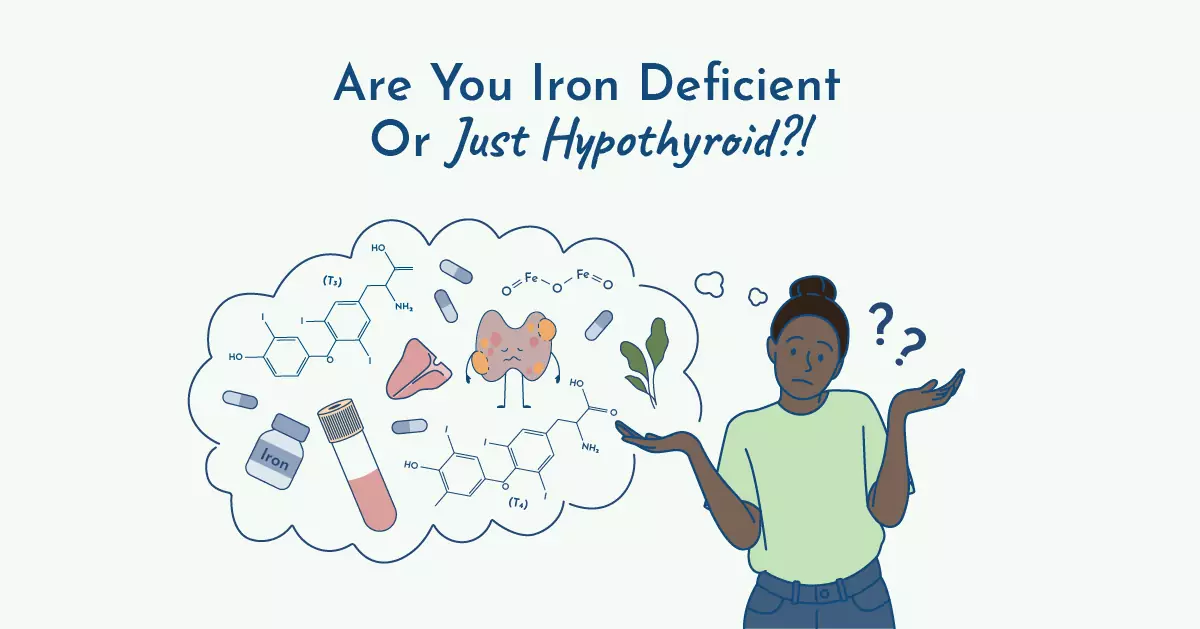
Have you suspected that you were iron deficient?
Maybe you had your ferritin tested and were told it was low…
So you started taking an iron supplement, assuming it was safe.
That seems logical.
It’s also one of the most common — and misunderstood — mistakes we see in people struggling with thyroid symptoms.
There’s a lot of misinformation out there about hypothyroidism.
And ferritin is right in the middle of it.
The idea that you can use a ferritin blood test to diagnose iron deficiency has become incredibly popular…
But here’s the problem…
When ferritin is taken out of context, it can push people toward decisions that quietly work against their health instead of helping it.
We see it all the time.
Well-meaning advice that says:
“Get your ferritin tested.”
“If it’s low, supplement iron.”
“Keep supplementing until you hit a certain number.”
Some even recommend iron based on symptoms alone.
Fatigue.
Hair loss.
Heart palpitations.
Sounds familiar, right?
Here’s the crazy thing…
Those same symptoms can also show up when iron levels are too high.
And they’re also classic symptoms of hypothyroidism itself.
So if you’re supplementing iron based only on symptoms — or a single lab value — you’re guessing.
And guessing with iron is not something you want to do.
The Truth About Hypothyroidism and Ferritin Labs
Most people are told that ferritin equals iron status.
Low ferritin? You must be iron deficient.
Normal ferritin? You’re fine.
That sounds simple… but it’s wrong.
Ferritin is not a direct measure of how much usable iron you have circulating in your blood.
It’s a storage marker — and it’s heavily influenced by thyroid hormone activity.
We’ve worked with many people who were supplementing iron based on ferritin alone.
When we ran more complete testing, their actual iron status was perfectly normal — or already high.
I’ll show you how to test true iron status in a minute.
True iron deficiency does exist.
But it’s far less common than people are led to believe.
Most cases are related to significant blood loss or absorption issues — not vague symptoms or routine fatigue.
So if it’s not iron deficiency, what’s driving low ferritin in so many people?
Here’s where the thyroid comes in.
Low or high ferritin is commonly observed in people with hypothyroidism.
Why?
Because thyroid hormone directly influences how iron is used, recycled, and stored throughout the body.
There’s research showing that when hypothyroid patients are brought back to normal thyroid function, ferritin levels rise — even without iron supplementation.
In other words…
Ferritin often responds to thyroid hormone, not only iron intake.
This isn’t new.
Decades ago, thyroid researcher Dr. Broda Barnes observed that low metabolic rate reduces red blood cell production in the bone marrow.
Lower metabolism — fewer red blood cells.
That alone can lower ferritin.
There’s also another pattern we see in people with hypothyroidism that rarely gets discussed.
Red blood cells can become fragile and break down more easily when metabolic function is low.
This is sometimes called hemolytic anemia.
In that situation, adding iron doesn’t solve the problem — and can actually make things worse.
So low ferritin is often not a deficiency problem at all.
It’s a thyroid signaling problem.
(Note: Looking for ways to better support your thyroid health? Discover how supporting your Thyroid Hormone Pathway can help, which we cover in more detail in this article on “The 5 Hidden Steps to Optimizing Your Thyroid Health (That Most People Miss)“.)
Fix the signal… and ferritin often normalizes on its own.
That’s why proper testing matters — iron supplementation without proper context can create more problems than it solves.
Iron Supplements and Iron Toxicity
Most people are surprised to hear this, but it’s true…
Many adults already consume plenty of iron — sometimes more than their body can comfortably handle.
Add to that the fact that many everyday foods are fortified with iron, and it’s easy to see how total intake can quietly add up over time.
Yet iron is different from many other nutrients.
Your body has very limited ways to eliminate excess iron.
So when intake exceeds what you can use, iron tends to accumulate.
Over time, that iron can be stored in organs like the liver, heart, and brain.
Chronically elevated iron stores have been associated with increased risk of:
- Liver dysfunction
- Cardiovascular issues
- Blood sugar dysregulation
- Neurodegenerative conditions
- Antioxidant depletion, including vitamin E
This doesn’t mean iron is “bad.”
We need iron to live.
But balance matters.
Think of it like exercise. Exercise is healthy… until it becomes excessive.
At that point, it becomes a stressor.
Iron works the same way.
More is not better. Context is everything.
How to Test Your True Iron Status
This is where most people go wrong.
Ferritin alone doesn’t tell the full story.
To understand iron status properly, you need to look at how much iron is circulating and how much capacity your blood has to carry more.
That’s where transferrin saturation comes in.
Transferrin is like a transport truck for iron.
Transferrin saturation tells you how full those trucks are.
Here’s how the patterns usually look:
- Low ferritin + low transferrin saturation — this can indicate true iron deficiency.
- Normal ferritin + high transferrin saturation — this suggests iron overload risk.
Both extremes matter.
Low iron can be a problem.
High iron can be a problem too.
Research has linked higher transferrin saturation — especially at the upper end of the reference range — with increased disease risk over time.
In practice, the lower end of the normal range is often where people feel and function best.
How to Alter Iron Absorption with Foods
One reason we’re cautious with iron supplements is because iron absorption is already very easy to influence with food.
Consuming Vitamin C (i.e. orange juice) with high iron foods (i.e. red meat) increases iron absorption.
Consuming coffee and caffeine with high iron foods reduces iron absorption.
You don’t need pills to fine-tune this.
In most cases, simply improving thyroid hormone function is enough to normalize ferritin without adding iron at all.
And if ferritin doesn’t respond?
That’s when we look deeper.
Is thyroid hormone actually reaching your cells?
Is there resistance along the Thyroid Hormone Pathway?
Are stress hormones, inflammation, or estrogen dominance blocking the signal?
If your body isn’t using thyroid hormone properly, your ferritin might not respond accordingly.
(Note: These are all factors that must be addressed for optimal thyroid health. Discover how we address them in more detail in this article on “The 5 Hidden Steps to Optimizing Your Thyroid Health (That Most People Miss)“.)
By now, one thing should be clear.
Ferritin is a downstream signal.
Iron is rarely the whole story.
Yes — taking iron can push ferritin higher.
But that doesn’t automatically mean you fixed the underlying issue…
It can just mean you forced the number up.
Here’s the problem…
If low ferritin is showing up because thyroid hormone isn’t getting where it needs to go on your Thyroid Hormone Pathway, then the real win isn’t “more iron.”
The real win is better signaling.
Better utilization.
Better metabolic output.
That’s why we always look at the full context first.
Not just ferritin.
Not just symptoms.
The whole picture.
KEY IDEA:
Low ferritin is often assumed to mean iron deficiency — but that assumption can quietly lead people in the wrong direction. Ferritin is a storage marker, not a diagnosis, and it’s strongly influenced by thyroid hormone activity. In many cases, low ferritin reflects how well thyroid hormone is being used, not how much iron you’re consuming. Adding iron can raise the number, but it doesn’t always fix the underlying issue — and unnecessary supplementation carries real risks, especially in a world where many foods are already fortified with iron. A smarter approach is to support healthy thyroid function first, use proper testing for context, and avoid blindly supplementing iron based on a single lab value.