
This is Part 3 of a 3-part series on supporting thyroid health:
- Part 1 –The 5 Hidden Steps to Optimizing Your Thyroid Health (That Most People Miss)
- Part 2 – Why Your Liver May Hold the Key to Better Thyroid Support
- Part 3 – [You Are Here] – The Low-Carb Diet Myth — And the Hidden Cost to Your Thyroid
The myth has long since been debunked. But unfortunately, some fads stick around long past their welcome.
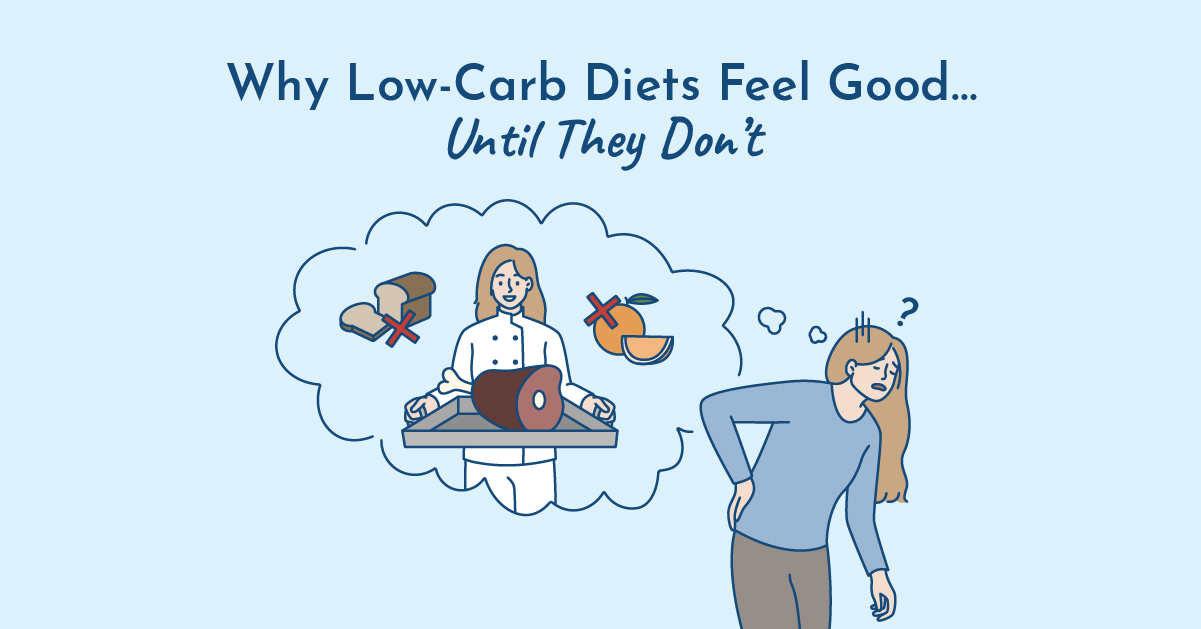
I’m talking about the low-carb diet myth.
I understand the thought process — and why it’s still hanging around.
Weight gain is a common symptom in people struggling with their thyroid health (yet so is unexplained weight loss).
And low-carb diets promote short-term weight loss.
So it must be healthy for your thyroid… right?
Well, you can also lose weight instantly by cutting off your left arm.
But that won’t support your thyroid either.
Don’t worry — we fell for it too.
Years ago, we spent a long stretch experimenting with low-carb eating because that’s what the experts were recommending.
At the time, it sounded scientific. Logical. Even cutting-edge.
But as the months went on, something didn’t feel right.

- Body temperature dropped.
- Hands and feet stayed cold.
- Energy crashed the moment the workday ended.
- Stress felt overwhelming — even small things.
The list goes on…
Little did we realize, the very diet that promised metabolic health was working against the Thyroid Hormone Pathway — the chain of events that allows thyroid hormone to be converted, activated, and used inside your cells.
And we’re not the only ones.
At least half the people we work with have tried some version of low-carb before they find us.
Many feel better at first…
But it doesn’t last.
Here’s why.
How a Low-Carb Diet Affects Thyroid Function and Metabolism
Let’s zoom out for a moment.
Your thyroid doesn’t work in isolation. It’s part of a pathway — production, conversion, transport, and cellular activation.
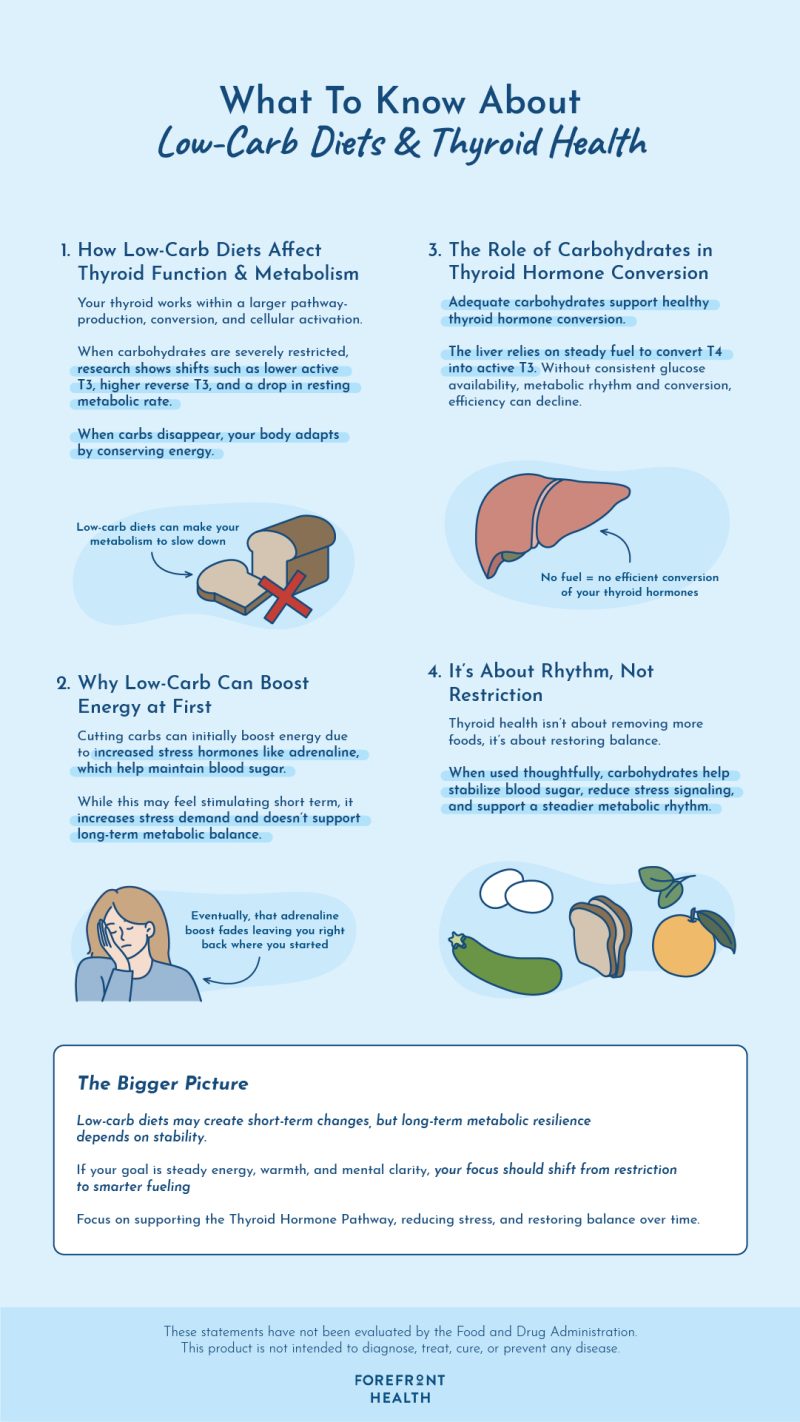
When carbohydrates are severely restricted, research shows consistent changes along this pathway:
- A reduction in active T3 thyroid hormone
- An increase in Reverse T3, a form that slows metabolic signaling
- A drop in resting metabolic rate
This is why so many people ask, “does low carb slow metabolism?” — because shifts in low carb T3 levels and increases in reverse T3 are consistently observed in research.
One published study observed a significant fall in triiodothyronine (T3) and rise in reverse T3 during ketogenic feeding, even when calories and protein were controlled.
Another found that carbohydrate restriction played a direct role in lowering resting metabolic rate during dieting.
In other words…
When carbs disappear, the body adapts by conserving energy.
That may look like weight loss at first.
But under the surface, metabolism is slowing.
And if you’re already struggling with fatigue, cold sensitivity, brain fog, or mood swings — that’s the last thing you need.
Why Low-Carb Can Boost Energy at First — Then Slow Your Metabolism
Now here’s the part that confuses people.
Many say, “But I felt great when I first cut carbs.”
That’s true.
When carbohydrates drop, blood sugar falls.
The body compensates by increasing stress hormones — especially adrenaline.
Adrenaline makes you feel alert. Focused. Even energized.
It’s like flooring the gas pedal in your car.
But you can’t drive like that forever.
Over time, prolonged carbohydrate restriction may influence how efficiently thyroid hormones are converted and utilized within the body.
At the same time, greater demands are placed on the body’s stress response, which may become less resilient over time.
The crazy thing is — your body is incredibly adaptable.
But it adapts for survival… not performance.
Eventually, that stress-driven boost fades. Energy dips return. Sleep becomes lighter. Mood becomes more reactive.

And you’re left wondering what went wrong.
Here’s the problem…
It wasn’t your discipline.
It wasn’t your willpower.
It was the strategy.
Over time, prolonged stress may contribute to more serious and long-term challenges — especially in a body that is already trying to conserve energy.
The Role of Carbohydrates in Thyroid Hormone Conversion
Now let’s flip the script.
Carbohydrates are not inherently harmful to thyroid health.
In fact, adequate carbohydrates play a supportive role in healthy thyroid hormone conversion and activity.
Your liver — one of the key organs in the Thyroid Hormone Pathway — relies on steady fuel (preferably from carbohydrates) availability to convert T4 into active T3.
And here’s where it gets interesting…
If the liver isn’t functioning efficiently, even ‘normal’ thyroid levels may not always align with how you feel.

That’s why we dedicated an entire article to this overlooked piece of the pathway — “Why Your Liver May Hold the Key to Better Thyroid Support“.
No fuel… no efficient conversion.
Without steady glucose availability, the liver struggles to maintain optimal thyroid hormone conversion and resting metabolic rate.
It’s that simple.
But this doesn’t mean you eat anything and everything.
It means you use the right carbohydrates, in the right amounts, at the right times.
When balanced properly, carbohydrates help stabilize blood sugar, reduce unnecessary stress signaling, and support a more steady metabolic rhythm.
Not a spike.
A rhythm.
And rhythm is what your thyroid thrives on.
Best Carbohydrates for Supporting Healthy Thyroid Function
Here’s what most people never hear…
You don’t fix thyroid struggles by removing more.
You fix them by restoring what the pathway needs.
That’s exactly why we created the 3 Food Triple-Thyroid-Boosting Daily Protocol.

It will walk you through how to use one of the most beneficial carbohydrates for supporting steady metabolic function.
This isn’t theory.
It’s informed by published research and years of clinical observation.
If you want to go deeper, we also recommend reading: The 5 Hidden Steps to Optimizing Your Thyroid Health (That Most People Miss)
Because once you understand the full pathway — not just one lab marker — everything starts to make more sense.
The Truth About Low-Carb Diets and Thyroid Health
Low-carb diets can create short-term changes.
But short-term weight shifts are not the same as long-term metabolic resilience.
If you’re in your 40s, 50s, 60s, or beyond and simply want to feel normal again — warm hands, steady energy, clear thinking — your body needs stability, not more restriction.
This isn’t about eating more.
It’s about eating smarter.

Support the pathway.
Reduce unnecessary stress signals.
Restore metabolic rhythm.
That’s how you move forward.
Take the first step.
And give your metabolism the steady support it’s been asking for.
KEY IDEA
Low-carb diets may create fast weight loss — but that doesn’t mean they support your thyroid. In fact, research shows carbohydrate restriction can shift T3 levels, increase reverse T3, and lower metabolic rate. That early burst of energy many people feel? It’s often driven by stress hormones — not improved thyroid function. Over time, that strategy can backfire, especially if you’re already dealing with fatigue, cold sensitivity, or stubborn weight changes. The truth is, your thyroid depends on steady fuel and proper hormone conversion. The right carbohydrates, used strategically, can support metabolic rhythm — not suppress it. If low-carb helped at first but didn’t last, this may explain why.