
Imagine this for a second…
You walk into your doctor’s office to discuss your latest lab work only to discover your total cholesterol is 400 mg/dL.
We all know that’s quite high.
Roughly double what it should be.
But what if your doctor points to the lab printout and tells you your cholesterol is well within the reference range and your heart is perfectly healthy?
Wouldn’t you be alarmed?

We certainly would.
Now here’s the crazy thing…
For many people struggling with ongoing thyroid symptoms, that’s exactly how receiving “normal” TSH results can feel.
They don’t feel like themselves.
They’re exhausted.
Their hair continues thinning.
Their weight won’t budge.
Their hands and feet are always cold.
Yet they’re told everything looks perfectly normal.
If you’ve ever wondered how you can have a normal TSH but still experience thyroid symptoms, you’re not alone.
Understanding what the TSH blood test actually measures is a good place to start.
But here’s the important question…
Could relying on TSH alone be overlooking part of the picture for some people?
It’s a question that has generated considerable discussion among researchers and clinicians for years.
The good news is…
There are additional ways to look at thyroid health beyond a single laboratory value.
We’ll get to those in a minute.
But before your next thyroid appointment, there’s something important you should understand about how the TSH test works and why its interpretation continues to be debated.
How Can Your TSH Be Normal if You Still Have Thyroid Symptoms?
The TSH test, also called the thyroid-stimulating hormone test, is one of the most common thyroid function tests used today.
While it’s an important screening tool, it represents just one aspect of evaluating thyroid health.
Like any laboratory test, the usefulness of a test depends on how its reference range is established.
Let’s go back to our cholesterol example.
If a dangerously high cholesterol level somehow fell inside the laboratory’s “normal” reference range, the problem wouldn’t necessarily be the cholesterol test itself.
The problem would be how the results were being interpreted.
The same principle applies to thyroid testing.
Today, the TSH test remains one of the primary tools used to evaluate thyroid function.
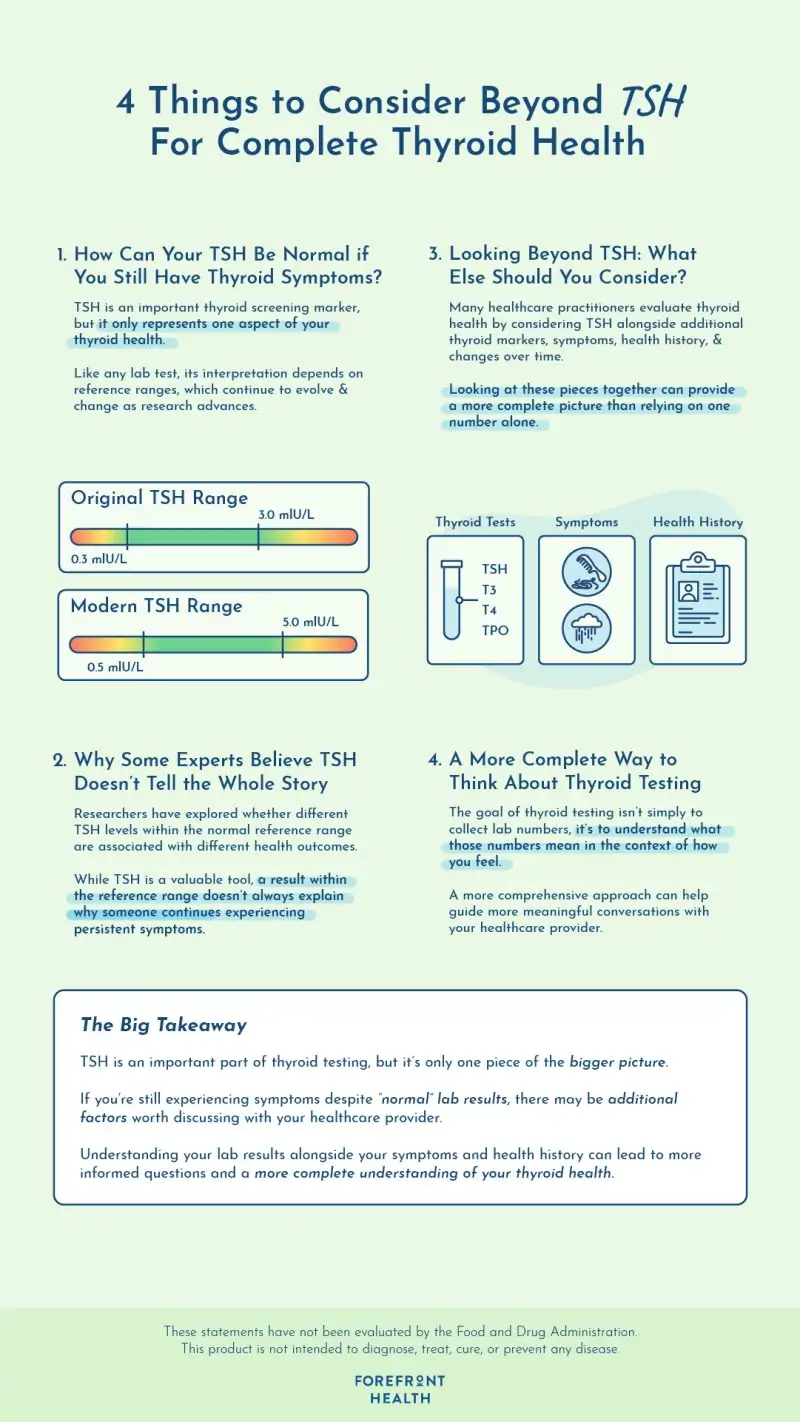
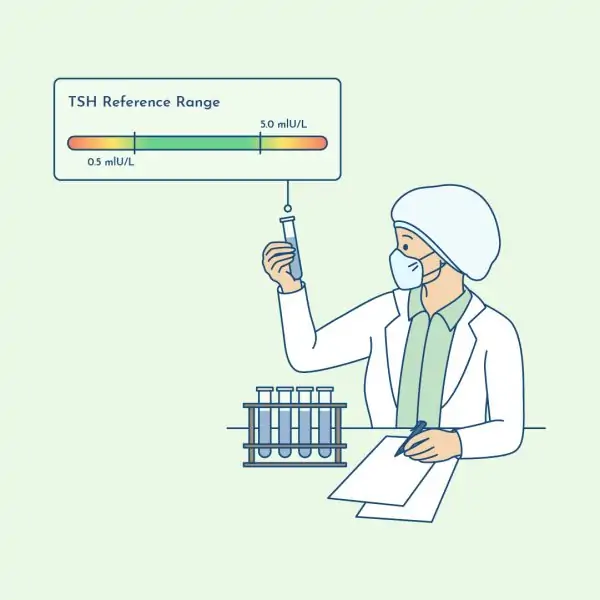
Most laboratories consider a TSH somewhere between approximately 0.5 and 5.0 mIU/L to fall within the laboratory reference range.
The exact numbers vary somewhat from lab to lab.
Here’s the problem…
Those reference ranges weren’t handed down as universal biological truths.
Like all laboratory reference ranges, they were developed from population data available at the time.
As our understanding of thyroid physiology has improved over the years, researchers have continued asking an important question…
Does the current reference range always reflect what is truly optimal?
That question has fueled decades of discussion.
In fact, professional organizations have debated whether the upper end of the TSH reference range should be lowered in an effort to identify more people who could benefit from further evaluation.
Depending on your symptoms and health history, some healthcare practitioners also consider Free T4, Free T3, and thyroid antibodies alongside TSH to gain a broader understanding of thyroid function.
While opinions continue to differ, one thing is clear…
Even within conventional medicine, the interpretation of TSH has evolved over time.
That tells us something important.
Reference ranges are not necessarily fixed forever.
They’re continually refined as new research becomes available.
Why Some Experts Believe TSH Doesn’t Always Tell the Whole Story
Now let’s look at one of the reasons this discussion continues.
Over the years, researchers have explored whether different TSH levels are associated with long-term health outcomes.
One observational study that generated significant discussion examined TSH levels and cardiovascular outcomes in women.
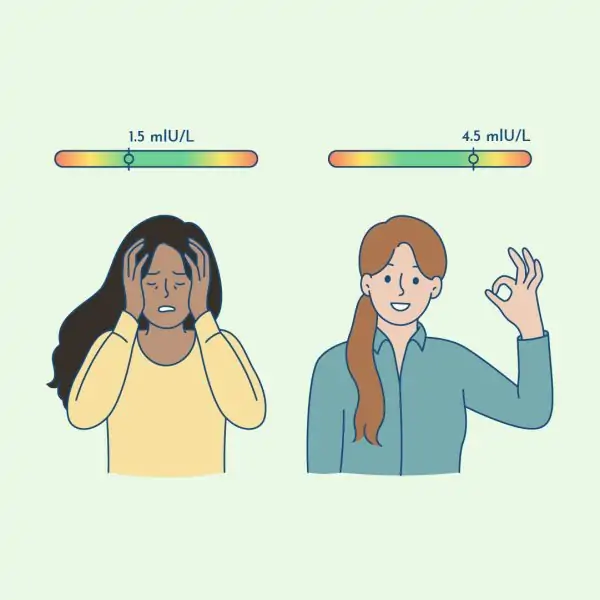
Researchers found that women with higher TSH levels within the laboratory reference range experienced higher rates of coronary heart disease than women whose TSH values were in the lower portion of the range.
These findings identify an association, not cause and effect.
Yet, findings like these have encouraged researchers to ask whether “normal” always means “optimal.”
That’s an important distinction.
Because laboratory reference ranges are designed to identify statistical averages.
They aren’t always designed to define the ideal physiology for every individual.
In other words…
A result that falls inside the reference range doesn’t necessarily explain why someone continues experiencing persistent symptoms.
And that’s where thyroid testing becomes much more interesting.
Looking Beyond TSH: What Else Should You Consider?
Looking beyond TSH doesn’t necessarily mean replacing it.
Instead, it’s about understanding how thyroid lab results, symptoms, and other thyroid markers fit together to create a more complete picture of your thyroid health.
Here’s something many people are never told…
TSH is only one piece of a much larger picture.
Think of it like looking at your car’s fuel gauge.
Knowing how much gas is in the tank is certainly useful.
But it doesn’t tell you whether the engine is running properly…
Whether the transmission is working…
Or whether the parking brake is still engaged.
You wouldn’t diagnose every car problem using a single gauge.
The same idea applies to thyroid health.
Many healthcare practitioners consider additional information alongside TSH when evaluating thyroid function.
That can include:
- Additional thyroid laboratory markers
- Your health history
- Your symptoms
- Changes over time
- Other physiological observations
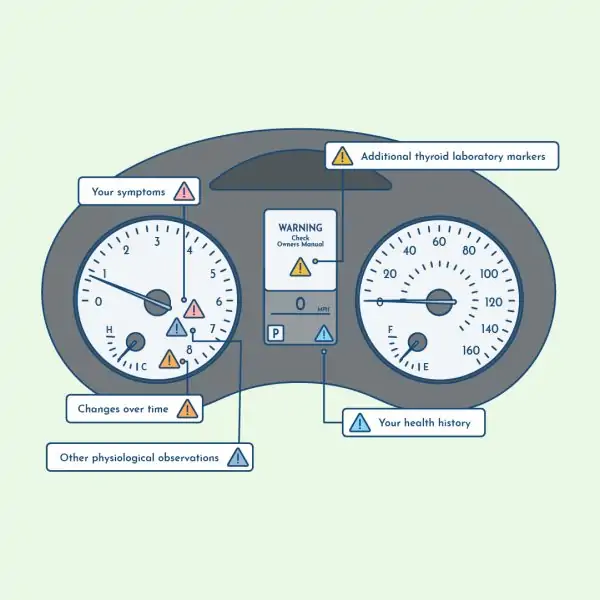
Looking at several pieces of information together often provides a more complete understanding than relying on one number alone.
This is especially important if you’ve continued feeling poorly despite laboratory results that fall within the reference range.
If that sounds familiar…
Please know this.
It’s not your fault.
Many people assume persistent symptoms automatically mean they’re doing something wrong.
Or worse…
That it’s simply part of getting older.
But sometimes the answer isn’t about trying harder.
It’s about asking better questions.
A More Complete Way to Think About Thyroid Testing
One of the biggest shifts we’ve made over the years is moving away from viewing thyroid health through a single laboratory value.
Instead, we encourage looking at the bigger picture.
What are your symptoms telling you?
How have they changed over time?
How do your laboratory results fit together?
Do they match how you actually feel?

Those are often the questions that lead to more meaningful conversations with your healthcare provider.
Because at the end of the day…
The goal isn’t simply to collect laboratory numbers.
The goal is understanding what those numbers mean within the context of your overall health.
Learn a More Comprehensive Approach
If you’d like to better understand how many practitioners evaluate thyroid health beyond a single laboratory value, we’ve put together an educational resource called the Ultimate Thyroid Testing Protocol.

Get more information about the Ultimate Thyroid Testing Protocol here.
Inside, we explain additional observations and considerations that may be useful when evaluating thyroid health and understanding how different pieces of the thyroid puzzle fit together.
Our goal isn’t to replace your healthcare provider.
It’s to help you become a more informed participant in your own care.
Because informed patients ask better questions.
And better questions often lead to better conversations.
Final Thoughts
The TSH test remains a useful tool.
But like every laboratory test, it has strengths and limitations.
That’s why researchers have continued studying how TSH should be interpreted and why the discussion has evolved over time.
If you’re still experiencing symptoms despite laboratory results that fall within the reference range, don’t assume your story ends there.
There may be additional pieces of the puzzle worth exploring with your healthcare provider.
Whether your goal is understanding your thyroid test results or learning how different thyroid hormone markers work together, having the full picture can help you ask more informed questions during your next appointment.
Remember…
A laboratory value is only one part of your thyroid story.
Understanding the bigger picture is often where the most valuable insights begin.

KEY IDEA:
Could your “normal” TSH result be leaving important questions unanswered? This article explores why TSH is only one part of evaluating thyroid health and why its interpretation has been debated for years. You’ll learn how thyroid reference ranges have evolved, why some researchers believe a single lab value doesn’t always tell the whole story, and why persistent symptoms deserve a broader conversation. Most importantly, you’ll discover why looking beyond TSH alone – by considering additional thyroid markers, symptoms, and the bigger clinical picture – may help you better understand your thyroid health and have more informed discussions with your healthcare provider.