


Imagine this for a minute…
You have this nagging cough that just won’t go away.
So, you make an appointment with your doctor.
After listening to your lungs, your doctor removes his stethoscope, looks you in the eyes, and says…
“There’s a 50% chance it will clear on its own and a 50% chance it’s something much more serious.”
Then he shakes your hand and tells you to come back in two months for another evaluation.
You’d probably be thinking…
“Wait… what?!?!?”

You’d want more information before making sense of what’s really going on, right?
You’d probably want additional testing.
You’d want to look at the full picture.
Because when it comes to your health, relying on a single piece of information rarely tells the whole story.
And yet…
That’s exactly what happens to millions of thyroid sufferers every single day.
Why So Many Thyroid Sufferers Still Feel Awful Despite “Normal” Labs
Sad but true.
Most people are told that one thyroid lab marker — usually TSH — is all that matters.
If it falls within range, they’re told everything looks “normal.”
Meanwhile, they’re still exhausted…
Still freezing cold…
Still struggling with brain fog, stubborn weight gain, thinning hair, poor sleep, constipation, low motivation, and a metabolism that feels like it completely slammed on the brakes.
This is one reason so many people search for answers to thyroid symptoms despite normal labs.

Here’s the crazy thing…
Many people are never taught that thyroid health is much bigger than a single lab number.
Because your thyroid doesn’t operate through one isolated marker.
It operates through what we call the Thyroid Hormone Pathway — the full chain of hormone production, activation, transport, cellular signaling, and how well your body actually responds to thyroid hormone.
In other words…
Looking at only one number while ignoring everything else is a little like trying to judge an entire movie from a single frame.
You miss the bigger picture.
Now, to be clear, blood testing absolutely has value.
But relying on one marker alone can sometimes leave important clues overlooked.
That’s why, instead of looking at only TSH in isolation, we prefer looking at more data collectively.
The more data you have, the better.
That’s why many thyroid sufferers begin exploring alternative thyroid tests that can provide additional insight beyond standard thyroid labs alone.
And today, I want to show you three alternative thyroid-related lab markers that may help you gather additional insight into what’s really going on beneath the surface…
Why Alternative Thyroid Tests Can Matter More Than You Think
One of the biggest mistakes we see thyroid sufferers make is becoming overly dependent on isolated lab numbers.
Those are just numbers.
What matters is the pattern those numbers create collectively.
Because here’s what happens all the time…
Someone gets told their labs are “normal,” but they still feel awful every single day.
Their energy is gone.
Their motivation disappears.
Their metabolism slows down.
Their sleep gets worse.
And deep down, they know something still feels off.
That’s not something you should ignore.
Here’s the problem…
Most conventional thyroid evaluations focus heavily on a narrow set of lab markers while overlooking other important pieces of context.

Things like:
- Symptoms
- Temperature
- Pulse
- Energy patterns
- Sleep quality
- Additional metabolic markers
When we work with clients, we don’t just look at one isolated number on a lab sheet.
We look at patterns.
That’s the foundation of a more comprehensive thyroid testing approach.
Because patterns tell a story.
For example, it’s incredibly common for someone to have “normal” labs on paper while simultaneously dealing with dozens of classic low-thyroid symptoms.
That disconnect matters.
And one of the most overlooked pieces of the puzzle is temperature and pulse.
Why?
Because thyroid hormone largely controls metabolic activity — your body’s ability to produce and use energy efficiently.
Your temperature and pulse can often provide additional context about how well your metabolism is functioning overall.
(Note: Want us to walk you through how to better understand your thyroid labs using temperature, pulse, and additional metabolic markers? In our free Ultimate Thyroid Testing Training Protocol, we show you step-by-step how to gather and interpret the data points that can help you see the bigger picture.)

You can access this thyroid testing protocol for free right here.
In other words…
We’re not just asking:
“Do you have thyroid hormone?”
We’re asking:
“How well is your body actually responding to and using thyroid hormone?”
That’s a completely different question.
And it’s one most people are never taught to think about.
This is why we teach people to collect more data instead of obsessing over one single lab marker.
Think of it like a detective building an evidence board…
One clue alone rarely solves the mystery.
But when enough clues start pointing in the same direction…
The bigger picture becomes much clearer.
Otherwise, you’re just throwing darts in the dark.
Now let’s look at three alternative thyroid-related markers that may help provide additional insight into your overall metabolic and thyroid health.
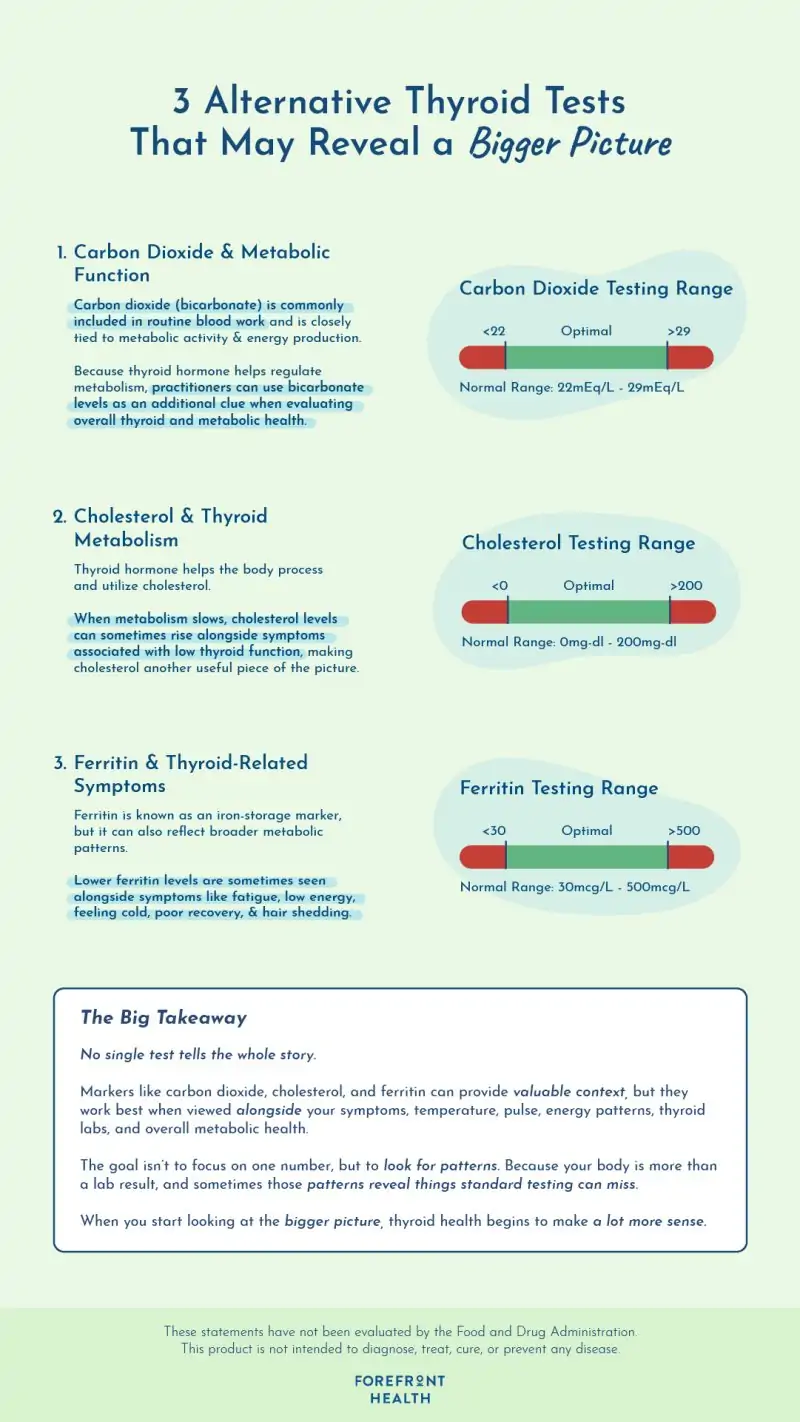
3 Alternative Thyroid Tests That May Reveal a Bigger Picture
Before we begin, let me make something very clear…
None of these markers should be viewed in isolation.
Instead, these additional thyroid markers should be evaluated alongside symptoms, standard labs, temperature, pulse, and overall metabolic patterns.
And none of them automatically mean you do or do not have a thyroid issue.
This is about collecting more information.
The more data points you have, the better.
That’s how you begin seeing patterns instead of isolated numbers.
Alternative Thyroid Test #1: Carbon Dioxide and Metabolic Function
Odds are you’ve already had this marker tested without even realizing it.
It’s commonly included in a standard metabolic panel during routine blood work.
Now here’s where things get interesting…
Carbon dioxide — also called bicarbonate — is tied closely to metabolic activity and energy production inside the body.
And because thyroid hormone plays a major role in regulating metabolism, some practitioners pay attention to where bicarbonate levels fall within the reference range.
In many cases, people with slower metabolic function tend to have lower carbon dioxide levels alongside symptoms commonly associated with low thyroid function.
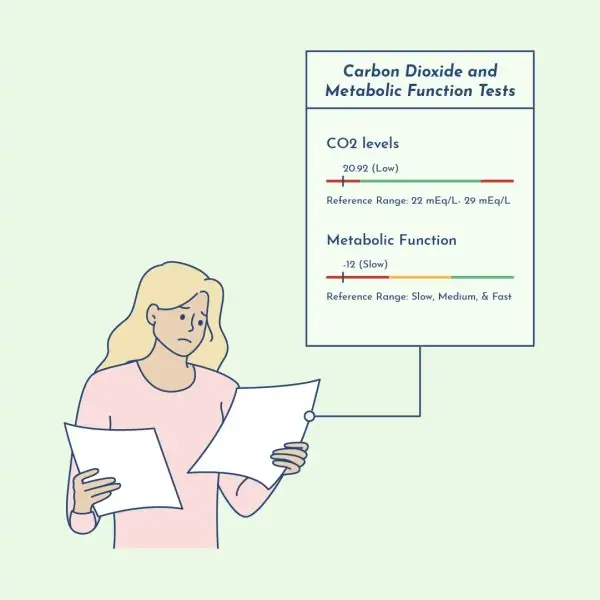
The reference range varies slightly between labs, but it’s commonly around 23 to 29 mmol/L.
Many practitioners who focus on metabolic health often prefer seeing bicarbonate levels toward the higher end of the range.
Again…
This isn’t about diagnosing anything from one number alone.
It’s about gathering clues.
Looking for patterns.
And building a more complete picture.
Because properly assessing thyroid function often requires more than a single blood marker.
Alternative Thyroid Test #2: Cholesterol and Thyroid Metabolism
This is another marker you’ve probably already tested before.
It’s included in a standard lipid panel.
Now here’s something most people are never told…
Thyroid hormone plays an important role in cholesterol metabolism.
In other words, cholesterol can sometimes reflect broader patterns involving thyroid metabolism and energy production.
In fact, before modern thyroid testing became common, cholesterol was one of several markers practitioners looked at when evaluating metabolic health patterns.
Here’s why this matters…
Thyroid hormone helps support the conversion and utilization of cholesterol throughout the body.
So when metabolic activity slows down, cholesterol levels can sometimes rise alongside it.
This is one reason some thyroid sufferers notice elevated cholesterol levels despite eating “healthy,” exercising, and trying to do everything right.

Frustrating, right?
Many practitioners who focus on thyroid and metabolism often pay close attention to total cholesterol trends — especially when combined with symptoms, temperature, pulse, and additional lab markers.
Again…
One number alone doesn’t tell the whole story.
But patterns matter.
Alternative Thyroid Test #3: Ferritin and Thyroid-Related Symptoms
Ferritin is commonly viewed as an iron-storage marker.
But here’s the crazy thing…
Ferritin levels can sometimes provide additional insight into metabolic and thyroid-related patterns too.
Why?
Because thyroid hormone helps influence energy production, oxygen use, and overall metabolic demand throughout the body.
And in some individuals dealing with lower metabolic function, ferritin levels may trend lower alongside symptoms like:
- Fatigue
- Hair shedding
- Feeling cold
- Poor recovery
- Low energy

Now, many people automatically assume low ferritin always means they’re simply iron deficient.
But sometimes the bigger picture is more complicated than that.
Several studies have observed a relationship between ferritin levels and thyroid function.
This is another reason why looking at symptoms and patterns collectively matters so much.
Many practitioners who focus on thyroid health often like seeing ferritin levels somewhere within a balanced mid-range rather than barely scraping the bottom of the reference range.
Again…
The goal here isn’t obsessing over a single number.
It’s understanding the bigger picture.
So, What Should You Do Next?
So there you have it…
Three alternative thyroid-related markers you can review that may help you better understand what’s happening beneath the surface.
Not because these tests magically diagnose everything…
But because they may help provide additional context.
And when you combine those markers with:
- Your symptoms
- Your temperature
- Your pulse
- Your energy patterns
- Your thyroid labs
- And your overall metabolic picture…
You start seeing patterns much more clearly.
Remember…
Your body is not a single lab number.
And one of the biggest mistakes people make is assuming “normal labs” automatically means everything is functioning optimally.
Sometimes the body tells a very different story.
That’s one reason hidden thyroid issues can sometimes go overlooked for years.
That’s also why we created our Ultimate Thyroid Testing Protocol.
You can access this thyroid testing protocol for free right here.
Inside, we walk you through:
- How to interpret common thyroid labs
- How to track temperature and pulse
- What patterns to look for
- And how to better understand the Thyroid Hormone Pathway as a whole
Because once you start looking at the bigger picture instead of isolated numbers…
Things often begin making a whole lot more sense.
And honestly…
You might be surprised by what you find.

KEY IDEA
Still struggling with thyroid symptoms despite “normal” labs? This article explores why a single thyroid marker like TSH may not always tell the full story. You’ll learn about three alternative thyroid tests — carbon dioxide, cholesterol, and ferritin — that may provide additional insight into your metabolism, energy production, and overall thyroid function. More importantly, you’ll discover why looking at patterns like symptoms, temperature, pulse, and metabolic markers together often paints a much clearer picture than isolated lab numbers alone. If you’ve been told everything looks “fine” but still don’t feel like yourself, this bigger-picture approach may help you better understand what’s really going on beneath the surface.