

Here’s a little-known truth about thyroid medication that almost no one tells you…
How you use it can shape your experience just as much as what you’re using.
Most people think thyroid support is all about finding the “right” pill, dose, or brand.
But after working with thousands of women, we’ve noticed something that completely changes the conversation:
The real game-changer is understanding how your body actually handles thyroid hormone once you take it.
I saw this firsthand with a woman I worked with recently.
She’d tried different medications, different strengths, different timing… and still felt like she was dragging herself through her days.
But when we walked through how she was using her medication — and the normal physiology behind it — something clicked.
Suddenly she understood why everything felt so up-and-down.

And more importantly… what questions to bring back to her doctor so her regimen actually fit her body’s rhythm.
A few months later, she told me she finally felt like herself again — more clear-headed, more steady, more capable of enjoying her work and her life.
And it all started with one realization:
The way your body absorbs, processes, and responds to thyroid hormone matters far more than anyone ever explained to you.
In this guide, we’ll break down three key factors that influence how your body handles thyroid hormone — so you can understand the “behind-the-scenes” physiology and have more informed conversations with your healthcare provider.
Before we go further, there’s one more key insight to understand.
Why T4 and T3 Behave So Differently in Your Body
Here’s something most people are never told when they’re handed a thyroid prescription:
T4 and T3 may both be thyroid hormones, but your body handles them in completely different ways.
And understanding these differences can help you make sense of why your medication routine feels the way it does — and what kinds of questions to bring to your healthcare provider.
Let’s walk through the basics.
T4: The Slow-and-Steady Storage Form
T4 is often described as your body’s “reservoir.”
It’s not immediately active — it first has to be converted into T3, the form your cells rely on for day-to-day energy needs within the thyroid-hormone pathway.
Because T4 has a longer active window (its half-life is roughly 1-2 weeks), it tends to behave more like a slow-drip system:
Think of a bucket with a tiny pinhole at the bottom.

The water drains very slowly, so the level stays fairly steady over time.
Add a little each day, and the bucket stays consistently full.
That’s how many doctors explain the way T4 builds up and stays relatively stable when someone takes it daily — it rises gradually over one to two weeks and doesn’t fluctuate dramatically from hour to hour.
This “steady reservoir” characteristic is one reason T4-only approaches are common in conventional care.
T3: The Fast-Acting, Short-Lived Form
T3 behaves very differently.
It’s already in its active form, and your cells can use it right away.
But it also has a much shorter active window — measured in hours, not days.
So the bucket analogy looks completely different here:
Imagine the same bucket… but with a much larger hole.

Water drains quickly.
If you want to keep the level consistent, you’d need to keep an eye on it and top it up more often.
This is how many practitioners describe the natural rise-and-fall pattern of T3 in the body.
Because it moves through the system more quickly, the timing and spacing of T3 can play a big role in how steadily it’s available throughout the day.
Some people notice this ebb-and-flow more than others, which is why doctors often tailor T3-containing regimens with more care and individualization.
Why This Matters for Your Experience
These differences don’t mean one form is “good” and the other is “bad.”
They simply reflect the way your thyroid-hormone pathway is naturally designed to work:
- T4 supports a more gradual, long-term pool.
- T3 supports quicker, moment-to-moment physiological activity.
Understanding how each one behaves can make the whole thyroid conversation feel less mysterious — and can help you collaborate more confidently with your healthcare provider about what feels most aligned with your body’s rhythm.
And while T3 isn’t always part of the standard prescription approach, it remains a key part of your thyroid’s natural hormone output — making it an important piece to understand when exploring how your body responds to different therapies.
(Note: If you’re exploring ways to support your thyroid-hormone pathway nutritionally, some people also look at whole-gland thyroid supplements as part of their wellness routines. Learn more about Raw Desiccated Thyroid here.)

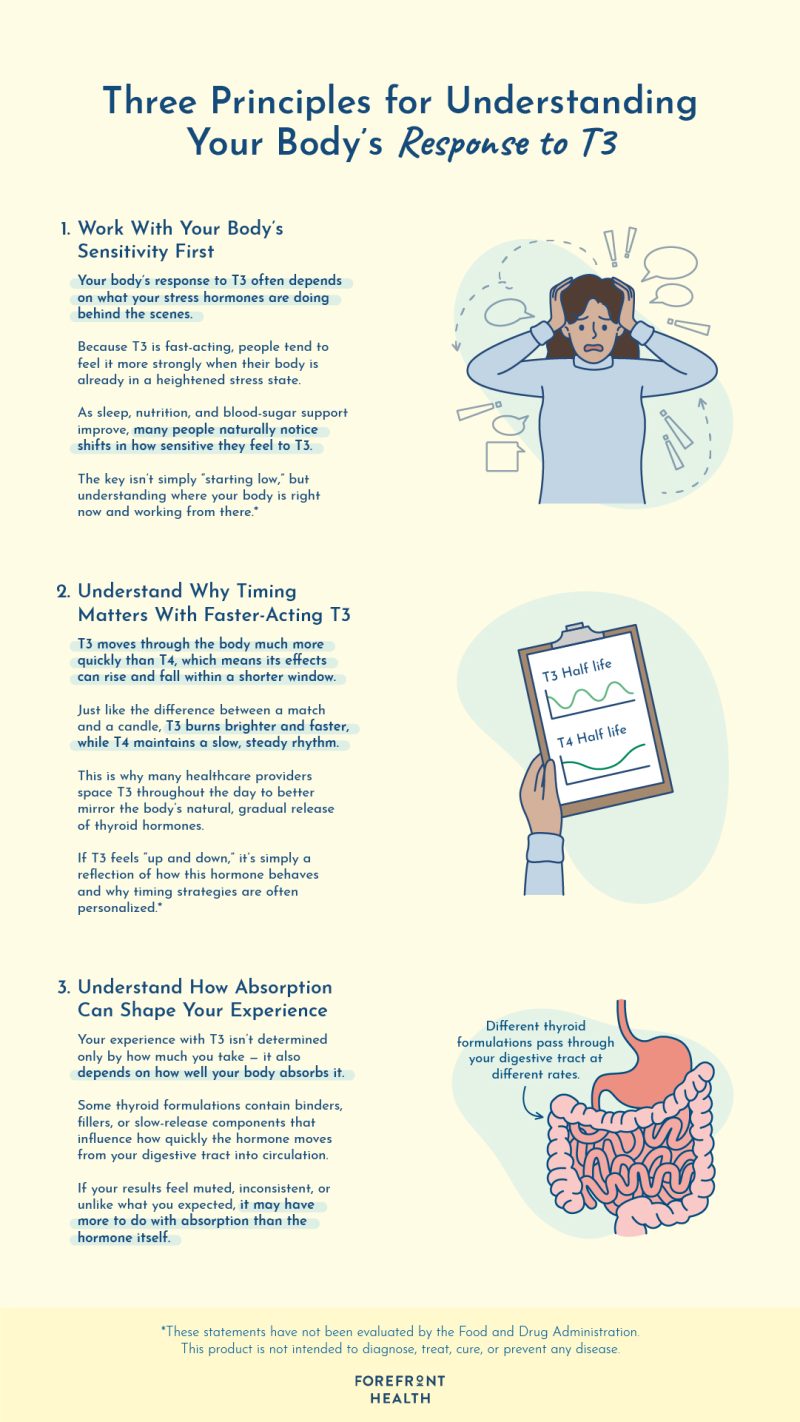
3 Principles for Understanding Your Body’s Response to T3
Here’s something many people are surprised to discover:
Your experience with T3 isn’t just about the dose on the label — it’s also about the internal environment you’re bringing it into.
Some people feel perfectly fine using T3.
Others describe feeling a little more “amped,” or more aware of their heartbeat or stress levels.
If that’s been your experience, you’re in very good company.
And the physiology behind it is actually pretty fascinating.
T3 is the faster-acting form of thyroid hormone, and your body uses it more immediately.
Because of that, it can interact with your natural stress hormones — particularly adrenaline — in ways that feel more pronounced when your system is already running in “high alert.”
Think of it like this:
When your stress response is elevated, your body is primed to react quickly.
Introducing an active hormone during that state can make those stress signals feel louder, even when the amount is small.

I’ve experienced this myself.
Years ago, during a nail-biting football game, I took my T3 later than usual.
Between the excitement of the game and the timing of the hormone, my internal “alarm system” felt like it shifted into an even higher gear.
It passed quickly — T3 has a short active window — but it taught me how important context is when your body is already in a heightened state.
This is why many doctors are thoughtful about how they introduce or adjust T3-containing medications.
It’s not that T3 is “good” or “bad” — it’s simply more noticeable, especially when your stress hormones are doing a lot behind the scenes.
Before We Get Into the Three Principles…
A quick reminder: If you’re currently using a thyroid medication that contains T3, always work with your prescribing provider before making any changes.
The principles we’re about to walk through apply to both T3-only and T3/T4 combination products, and they’re meant to help you understand the why behind the experience—not to guide your dosing.
Ready?
Let’s dive into the three key patterns that help explain how your body handles T3.
1. Work With Your Body’s Sensitivity First
Here’s one of the biggest “hidden factors” most people never hear about:
Your body’s sensitivity to T3 depends heavily on what your stress hormones are doing behind the scenes.
T3 is the active, fast-moving form of thyroid hormone.
Because your cells can use it right away, many people find they feel it more noticeably — especially when they’re already in a heightened stress-response state.
That’s why doctors often take a gradual, individualized approach when introducing T3-containing medications.
It’s less about the number on the label and more about understanding how your body responds in the beginning.
Think of it like easing into a warm pool instead of jumping straight into the deep end.
A gentler introduction gives your system space to adjust, especially if adrenaline or other stress signals are already running high.

Over time, as your internal stress chemistry finds a steadier rhythm — through sleep, nutrition, blood-sugar support, or your broader thyroid-care plan — many people notice that their sensitivity shifts.
That’s when prescribing providers may adjust things based on a person’s unique tolerance and response.
The key idea here isn’t “start low” as a rule.
It’s “start by understanding where your body is right now and build from there.”
2. Understand Why Timing Matters With Faster-Acting T3
Here’s another piece of insider physiology most people never hear:
T3 moves through the body much faster than T4, which means the timing of how it’s introduced can shape the way you feel throughout the day.
Most people are familiar with T4’s “slow and steady” nature—it builds gradually, stays in circulation longer, and doesn’t rise or fall dramatically from hour to hour.
T3 is different.
Because it has a shorter active window, its levels naturally rise and decline more quickly after it’s taken.
That means some people notice distinct peaks and valleys in how their body responds, especially when the entire day’s amount enters the system all at once.
Think of it like lighting a match versus lighting a candle.
A match flares brightly and then burns out fast.
A candle burns more steadily over time.

This difference in rhythm is why many doctors tailor T3-containing regimens differently than T4-only ones.
They may spread the amount across the day or use other timing strategies to better mirror the way the thyroid gland naturally releases small amounts of hormone in a gradual, hour-by-hour pattern.
Digestion and individual sensitivity also play a role.
Some people feel T3’s effects more intensely early on, while others experience a smoother response.
The key takeaway:
If T3 feels “up and down,” it’s not you—it’s simply the nature of how the hormone behaves.
This is exactly why many healthcare providers personalize the timing and spacing of T3 to fit the individual, not the clock.
3. Understand How Absorption Can Shape Your Experience
Here’s something that surprises a lot of people:
Your body’s response to T3-containing products isn’t only about the amount — it’s also about how well your digestive system breaks down and makes that hormone available.
Different thyroid formulations dissolve at different rates.
Some contain binders, fillers, or slow-release components that influence how quickly the hormone moves from your digestive tract into circulation.
Others break down more readily and enter the system faster.
This isn’t “good” or “bad” — it’s simply part of the normal variability between products.
It also explains why two people using the same type of medication may describe very different experiences, and why doctors sometimes explore alternative formulations if the initial one doesn’t seem to match a person’s needs or sensitivity level.
If someone feels like their response is unusually muted or inconsistent, absorption is one of the many physiological factors practitioners may consider.
Digestive health, timing, stomach acidity, and the specific product’s design can all play a role in how steadily the hormone becomes available.
The important takeaway is this:
If your experience doesn’t match what you anticipated, it doesn’t always reflect the hormone itself — sometimes it’s simply about how your body is absorbing it.
So, there you have it.
Most people focus only on what thyroid hormone they’re using…
But the “how” behind it — the timing, the form, the way your body absorbs it — often explains far more about their day-to-day experience.
Understanding these patterns doesn’t replace medical guidance, of course.
But it does give you a clearer picture of what’s happening inside your body and helps you ask more informed questions as you work with your healthcare provider.

Sometimes it’s these small, behind-the-scenes insights that shift everything — helping your regimen feel more aligned with your natural rhythm and giving you more confidence in your own thyroid-health journey.
And if you’re exploring ways to support your thyroid-hormone pathway from a nutritional angle, many people also look at whole-gland thyroid supplements as part of their wellness routine.
Learn more about Raw Desiccated Thyroid here.

KEY IDEA
If your thyroid medication has ever felt inconsistent, you’re not imagining it. T3 and T4 behave very differently in the body, and those differences shape how steady — or unpredictable — your medication can feel. This guide breaks down three hidden principles most people never hear about: how the body’s stress chemistry affects T3 sensitivity, why timing and spacing matter, and how absorption can influence your day-to-day experience. These insights help you understand what’s happening behind the scenes with your medication. When you understand the “why,” the whole thyroid conversation becomes clearer — and you can finally make sense of how your body responds.