
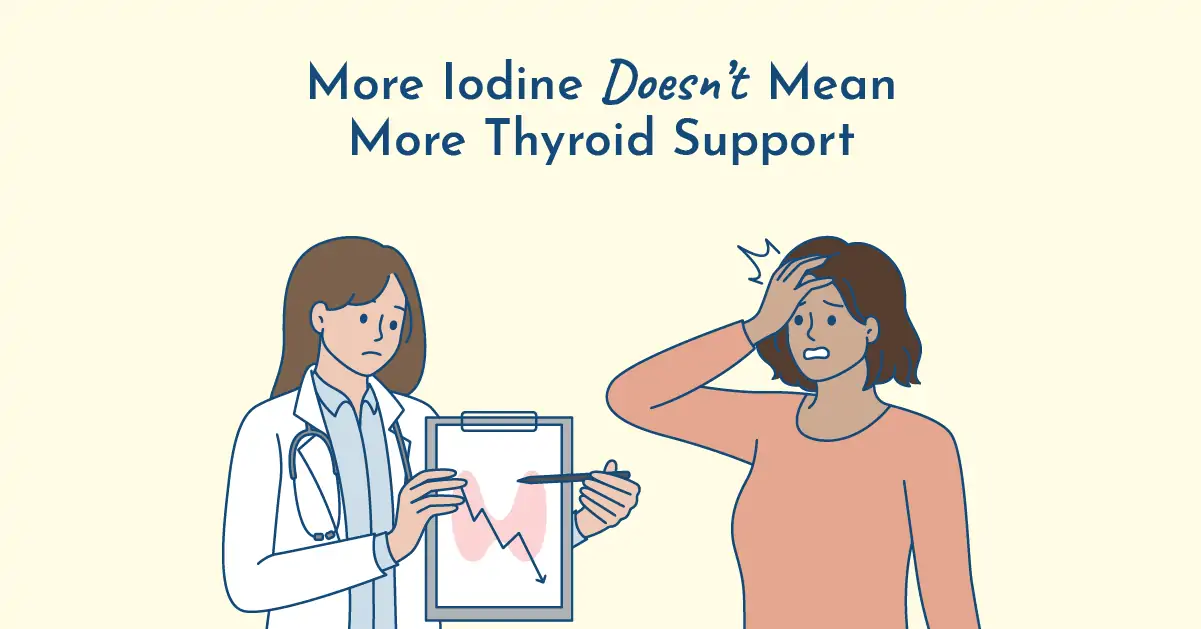
Iodine supplementation has become quite popular among people struggling with low thyroid function today.
Much of its popularity comes from its historical use in treating goiters centuries ago.
But today, could it be causing more harm than good?

It is well known that your thyroid gland requires iodine to produce thyroid hormone.
That’s not up for debate.
But here’s the problem…
If you’re researching iodine supplements for hypothyroidism, there’s another side of the story you need to understand: the potential dangers of excessive iodine intake.
And when you look at some of the amounts being recommended today, you’ll understand why this deserves far more attention.
Dangers of Excessive Iodine for Thyroid Health
When most people think about iodine and thyroid health, they think about one thing…
Iodine deficiency.
And it makes sense.
When it comes to iodine and thyroid function, your thyroid needs iodine to produce thyroid hormone, so it’s easy to assume that if some iodine is good, more must be better.
But that’s where things can go wrong.
Iodine deficiency can certainly occur, and iodine status can vary depending on your diet, location, and other factors.
Yet there’s another side of the iodine story that gets far less attention.
Excessive iodine can create problems for healthy thyroid function too.
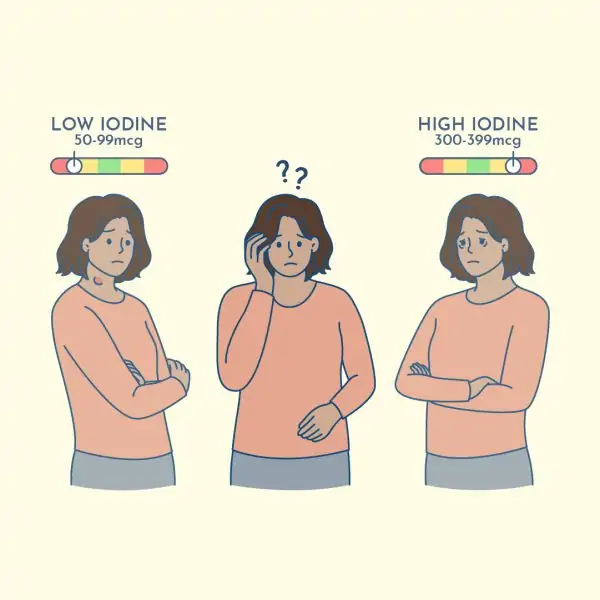
The recommended dietary allowance (RDA) for iodine in adults is 150 mcg (micrograms) per day. This includes iodine from your food as well as supplements.
Yet concerns about excessive iodine intake are nothing new.
As early as the 1970s, researchers were reporting iodine intakes in the U.S. that greatly exceeded estimated requirements in some populations.
With so much focus on iodine’s historical role in treating iodine-deficiency goiter, as well as its essential role in thyroid hormone production, much less attention has been placed on what happens when iodine intake becomes excessive.
And as you’re about to see…
More isn’t always better.

History of Iodine Therapy
The use of iodine-containing remedies for goiters was documented thousands of years before anyone even understood the thyroid gland.
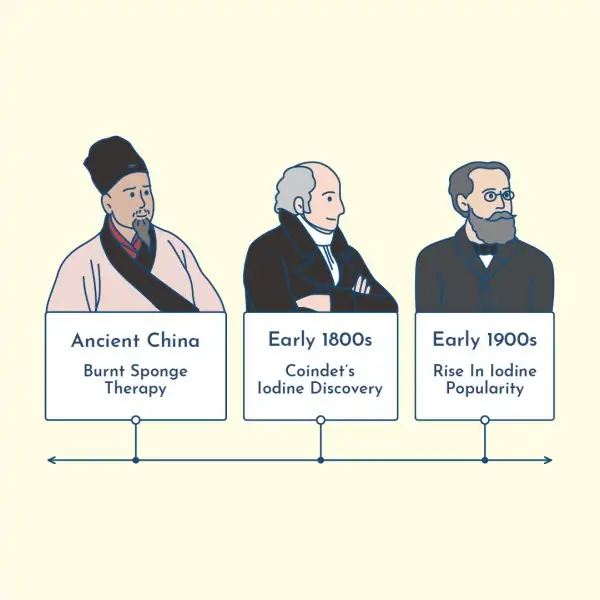
One of the earliest documented examples goes as far back as ancient China.
At the time, what was understood simply as a swollen neck was treated with remedies that included burnt sponge.
Strange, right?
Yet burnt sponge continued to appear as a remedy for goiter for centuries.
Nobody knew why it appeared to work.
Then, in the early 1800s, iodine changed everything.
French physician Jean-François Coindet began using iodine after recognizing the connection between iodine and traditional burnt-sponge remedies.
And iodine therapy quickly gained attention.
But here’s the part of the story that’s often forgotten…
Concerns about excessive iodine appeared almost immediately.
Coindet himself observed adverse effects associated with excessive iodine use and warned about the importance of dosing.
So, concerns surrounding too much iodine aren’t some new discovery.
They go back more than 200 years.
History Repeats Itself – When Will We Learn From Our Mistakes?
When I was a young kid in school, I once questioned my history teacher about the importance of studying history.
His answer was simple.
We study history so we don’t make the same mistakes over again.
It made sense to me then.
And it still does today.
Yet when it comes to health, we have a funny way of forgetting the lessons we’ve already learned.
After Coindet’s work in the 1800s, iodine became incredibly popular.
It became readily available and enthusiasm surrounding it grew dramatically.
But the enthusiasm didn’t last forever.
As iodine use increased, so did reports of problems associated with excessive intake.
Then history repeated itself…
In 1896, Eugen Baumann discovered that the thyroid gland was rich in iodine.
That discovery helped cement the connection between iodine and thyroid function.
And once again, iodine became a major focus in the treatment of thyroid disorders in the early 1900s.
The reasoning seemed obvious:
Your thyroid contains iodine.
Your thyroid needs iodine.
Therefore, giving it more iodine should make it work better.
Sounds logical.
But biology isn’t always that simple.
Iodine Deficiency Is Not the Only Factor in Thyroid Health Today
By the 1940s, advances in thyroid research were making something increasingly clear.
Researchers already understood the connection between iodine deficiency and reduced thyroid function…
But iodine wasn’t the whole story.
If simply providing more iodine solved every thyroid problem, then increasing iodine availability should have dramatically reduced thyroid problems across the board.
That didn’t happen.
The prevalence of goiter declined in many areas as iodine availability improved, including through changes in agriculture and the introduction of iodized salt.
But thyroid problems didn’t disappear.
This helped reinforce an important distinction.
Adequate iodine is necessary for healthy thyroid function, but iodine status is only one piece of a much larger thyroid puzzle.
Researchers continued investigating the many dietary, environmental, hormonal, and physiological factors that can influence thyroid function.
And that’s important to understand.
Because if you’re struggling with low energy, feeling cold, brain fog, changes in your hair, or other ongoing thyroid-related symptoms, it’s tempting to search for the one missing nutrient that will finally make everything click.
I understand the appeal.
But your thyroid doesn’t operate in isolation.
And simply supplying dramatically more of one nutrient doesn’t necessarily provide the broader support your thyroid and body need.
Problems with Iodine Supplements for Hypothyroidism
Now let’s put some actual numbers behind this.
Because when it comes to iodine dosage, the difference between nutritional requirements and some high-dose protocols can be enormous.
The RDA for iodine in adults is:
150 micrograms per day.
Yet some high-dose iodine supplements and protocols recommend amounts ranging from approximately 12.5 mg to 100 mg per day.
Remember, there are 1,000 micrograms in just one milligram.
So what does that mean?
Some of these amounts provide roughly:
80 to 650 times the recommended daily allowance of iodine.
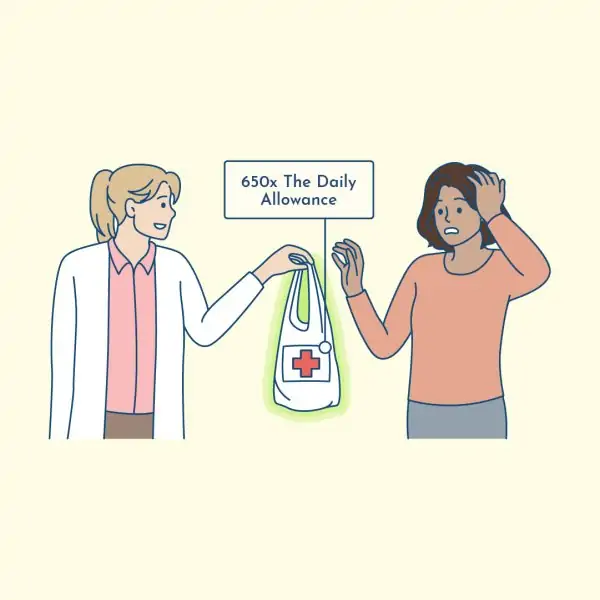
Think about that for a second.
We’re not talking about 20% more.
Or even twice as much.
We’re talking about amounts that can be dozens to hundreds of times greater than the recommended daily intake.
And that’s why concerns about excessive iodine intake and iodine toxicity deserve to be taken seriously.
At doses this high, we’re no longer talking about simply meeting your body’s nutritional requirement for iodine.
And that raises an important question…
What happens to your thyroid when you consume far more iodine than it actually requires?
This is where things get interesting.
Because excessive iodine doesn’t simply pass through your thyroid without consequence.
It can influence thyroid physiology in some very important ways.
Here are three you should know about.
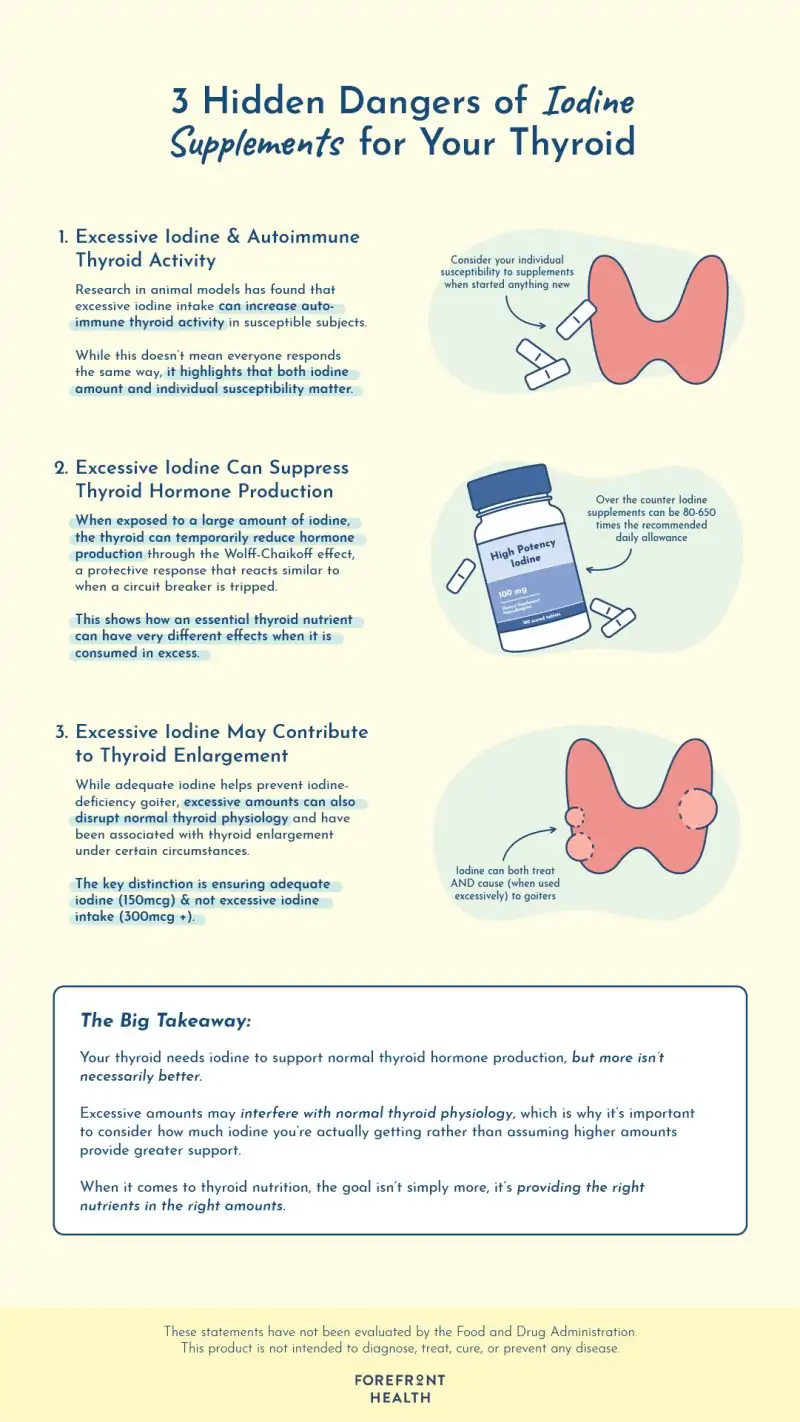
Danger #1 – Excessive Iodine and Autoimmune Thyroid Activity
One of the biggest concerns surrounding excessive iodine involves thyroid autoimmunity.
This isn’t based on theory alone.
Researchers have investigated the relationship between iodine exposure and autoimmune thyroid activity for decades.
Animal research, for example, has shown that excessive iodine intake can increase or accelerate autoimmune thyroiditis in susceptible animals.
One study published in Science, titled “Induction of autoimmune thyroiditis in chickens by dietary iodine,” found that increasing dietary iodine was associated with autoimmune thyroiditis in the experimental model.
Other animal research has similarly found that excess iodide intake can aggravate autoimmune inflammatory activity.
A review of iodine and thyroid autoimmunity in animal models summarized the concern this way: iodine excess can accelerate autoimmune thyroiditis in autoimmune-prone animals.
Now, animal research doesn’t mean the exact same response occurs in every person taking iodine.
But it does reveal something important…
Your thyroid’s response to iodine depends on more than simply whether iodine is present.
The amount matters.
And individual susceptibility matters too.
That’s an important distinction that’s often missing from the “more iodine is better” conversation.
Danger #2 – Excessive Iodine Can Suppress Thyroid Hormone Production
Here’s where iodine becomes even more interesting.
Your thyroid has a built-in protective response to large amounts of iodine.
It’s called the Wolff-Chaikoff effect.
Sounds complicated.
The concept isn’t.
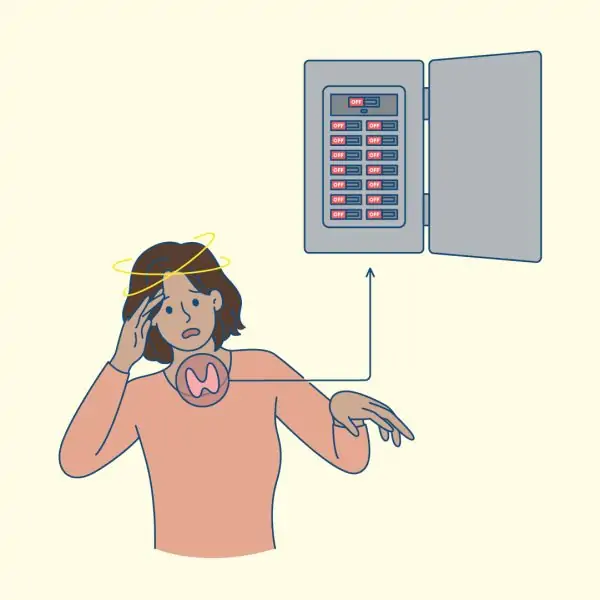
When your thyroid is suddenly exposed to too much iodine, it can temporarily reduce thyroid hormone production.
Think of it like a circuit breaker.
When the system becomes overloaded, the thyroid essentially hits the brakes.
This response is one reason high-dose iodine has historically been used in specific medical situations involving excessive thyroid activity.
In many people, the thyroid eventually “escapes” from this effect and normal thyroid hormone production resumes.
But that doesn’t always happen the same way in everyone.
Certain individuals appear more susceptible to iodine-induced changes in thyroid function, and persistent effects have been reported under certain circumstances.
The takeaway here is…
The nutrient your thyroid needs to produce thyroid hormone can, in excess, trigger a physiological response that temporarily reduces thyroid hormone production.
That’s the paradox.
And it’s exactly why “your thyroid needs iodine” doesn’t automatically translate into “the more iodine, the better.”
Danger #3 – Excessive Iodine May Contribute to Thyroid Enlargement
Here’s another strange twist in the iodine story.
Most people associate iodine with preventing goiter.
And in cases of iodine deficiency, adequate iodine is obviously important.
But excessive iodine can also disrupt normal thyroid physiology and has been associated with thyroid enlargement under certain circumstances.
There are a couple of ways this can occur…
First, excessive iodine can promote changes in thyroid-cell growth, contributing to enlargement of the thyroid while interfering with normal thyroid hormone production.
Second, excessive iodine has been associated with iodide myxedema, which involves connective-tissue buildup and fluid accumulation around the neck and thyroid.
Again, the important lesson isn’t that iodine is “bad.”
Far from it.
Iodine is an essential nutrient.
The problem is assuming that because your thyroid needs iodine, dramatically increasing your intake must automatically improve thyroid function.
That’s simply not how thyroid physiology works.
And that’s the larger point behind all three of these dangers.
More Iodine Isn’t Necessarily Better for Thyroid Health
So there you have it…
Iodine plays an essential role in thyroid health.
Without enough iodine, your thyroid can’t produce normal amounts of thyroid hormone.
But that doesn’t mean more is always better.
And it certainly doesn’t mean that taking dozens or even hundreds of times the recommended daily intake is something to approach casually.
That’s the distinction we want you to understand.
Adequate iodine supports healthy thyroid hormone production. Excessive iodine can interfere with normal thyroid physiology.
So instead of falling for the latest and greatest thyroid supplement “fad,” take the time to understand what you’re putting into your body.
Look at the actual dose.
Compare it with normal nutritional requirements.
And remember that your thyroid depends on much more than any single nutrient.
Because when it comes to supporting your thyroid…
The goal isn’t simply more.
It’s giving your body the right support, in the right amounts, for the processes healthy thyroid function depends on.
KEY IDEA
Your thyroid needs iodine to produce thyroid hormone. So, it seems logical that more iodine would provide even more thyroid support.
But that’s not always how it works.
Some high-dose iodine protocols recommend roughly 80 to 650 times the recommended daily allowance. And excessive iodine can affect your thyroid in surprising ways.
Discover the overlooked history of iodine therapy, why more iodine isn’t necessarily better, and three potential dangers of excessive iodine intake, including its effects on thyroid autoimmunity, thyroid hormone production, and thyroid enlargement.
When it comes to iodine and your thyroid, the right amount matters.