
Ever felt like you were under a lot of stress?
Well, you’ve never seen stress like we’re about to show you in this case study.
That’s right.
This is an extreme hypothyroidism case study.
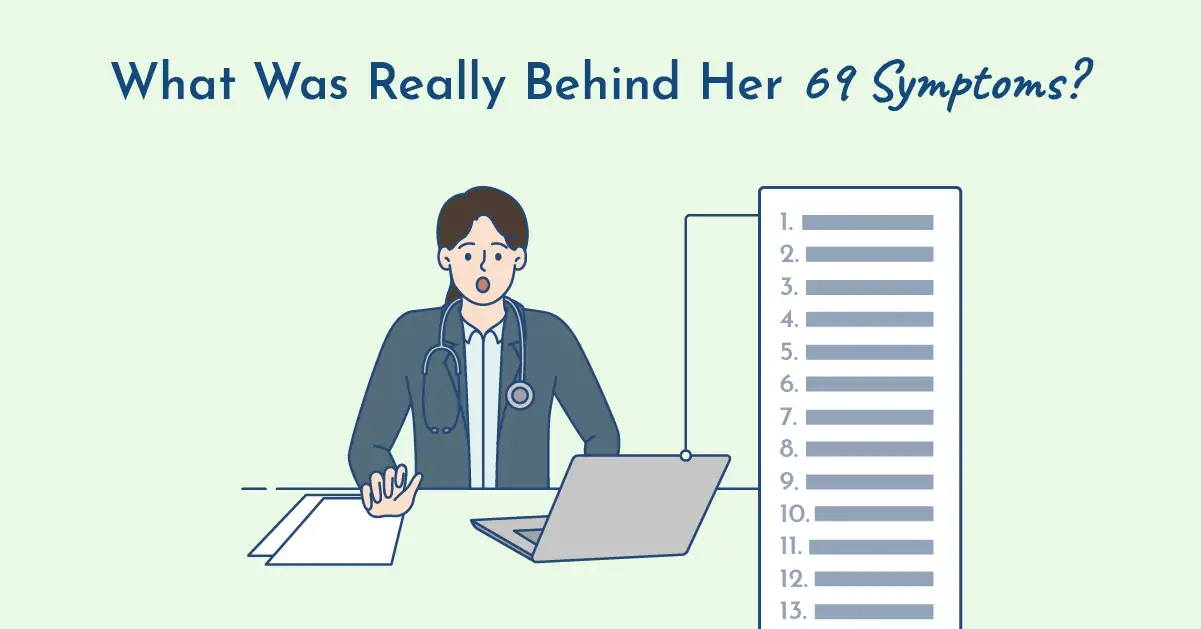
We have all clients fill out our Thyroid Symptom Checklist.
It’s not uncommon for clients to check off 20 to 30 thyroid symptoms on the list.
This young woman checked off 69 of them.
No wonder she felt so horrible.
And it all boils down to stress…
Case Study Background: Hypothyroidism and Stress
To understand the connection between hypothyroidism and stress, we first need to look at what we call the Thyroid-Adrenal Stress Cycle.
In short, lower thyroid function can promote a stronger stress response, while a stronger stress response can further slow thyroid function, potentially creating a cycle that makes it harder to maintain healthy thyroid function.
That’s why stress hormones and thyroid function shouldn’t be looked at in isolation.
And thyroid dysfunction isn’t the only factor involved.
Severe acute stress can play a role as well.
As it turns out, our case study subject’s thyroid problems were first diagnosed during a period of significant physiological stress, including receiving a shot of adrenaline.
But that was just the beginning.
A year later, she suffered a broken back in a motorcycle accident, adding another major source of physiological stress.
If that’s not severe acute stress, we don’t know what is.
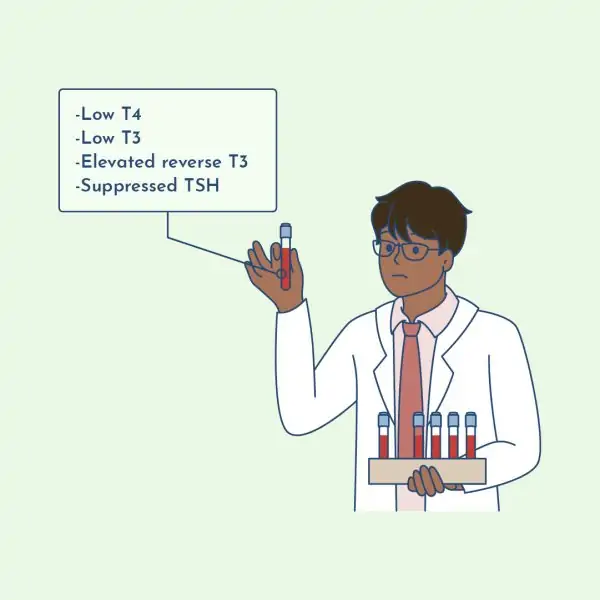
Her thyroid labs also showed clear abnormalities:
- Low T4
- Low T3
- Elevated reverse T3
- Suppressed TSH
But here’s where the bigger picture becomes important.
Take a look at her body temperature throughout a given day:
- Basal Waking Temperature: Commonly elevated.
- Post Meal Temperatures: Often decline.
- Afternoon Temperature: Consistently above normal.
(NOTE: Body temperature and pulse can provide additional context when looking at thyroid function alongside thyroid labs. You can learn more about how and why in our free thyroid testing training.)
When we see consistently elevated body temperature, there are a number of possible factors to consider.
Hyperthyroidism is one.
Yet her thyroid labs didn’t fit that picture.
Another factor we considered was her stress response.
Her unusual temperature patterns, considered alongside her labs and symptoms, were another possible sign of an elevated stress response.
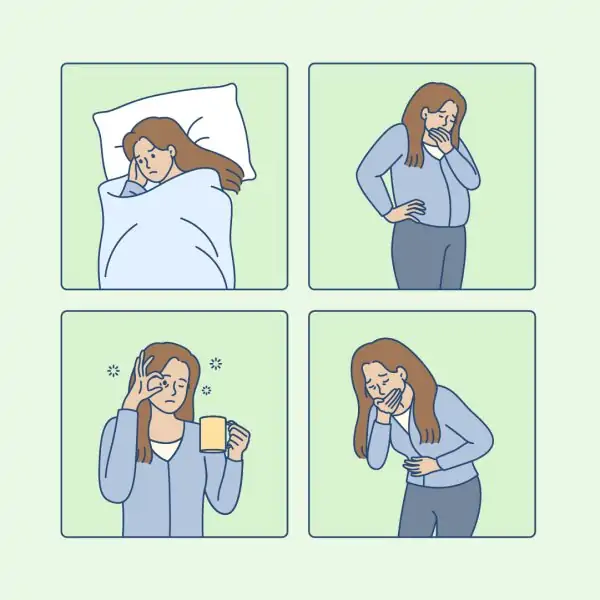
Plus, our subject exhibited a number of symptoms and health concerns often seen alongside chronic stress, including:
- Severe insomnia
- Accumulation of belly fat
- Insulin resistance
- Low sodium levels
Now, this is where things get interesting.
The 4 Primary Thyroid-Stress Activators
Whenever we see signs of an overactive stress response, we want to understand what might be contributing to it.
We don’t look at one lab marker and call it a day.
We look at diet and nutrition logs, temperature and pulse logs, labs, symptoms, health history, and the bigger picture they create together.
This often leads us to investigate what we call the four primary thyroid-stress activators:
- Low Blood Sugar
- Estrogen Dominance
- Excess Serotonin
- Excess Endotoxin
Each can interact with thyroid and metabolic function while also influencing the body’s stress response.
What’s interesting is that we didn’t find evidence pointing toward just one or two of these thyroid-stress activators in our case study subject.
We found signs pointing toward all four.
Let’s take a quick look at how we came to this conclusion…
Thyroid-Stress Activator #1: Low Blood Sugar
Your liver plays an important role in keeping your blood sugar stable.
One way it does this is by storing glucose as glycogen and releasing it when your body needs more fuel.
Here’s where the connection between thyroid function and blood sugar becomes important.
Lower thyroid function can impair the liver’s ability to store and release glycogen, which can make maintaining stable blood sugar and fuel for your cells more difficult.
And when blood sugar drops too low, your body has a backup plan.
It releases stress hormones, including adrenaline and cortisol, to help make more fuel available.
That’s useful in an emergency.
The problem comes when your body has to rely heavily on that stress response over and over again.
Over time, repeatedly relying on stress hormones like cortisol and adrenaline can become another important part of the thyroid-stress picture.
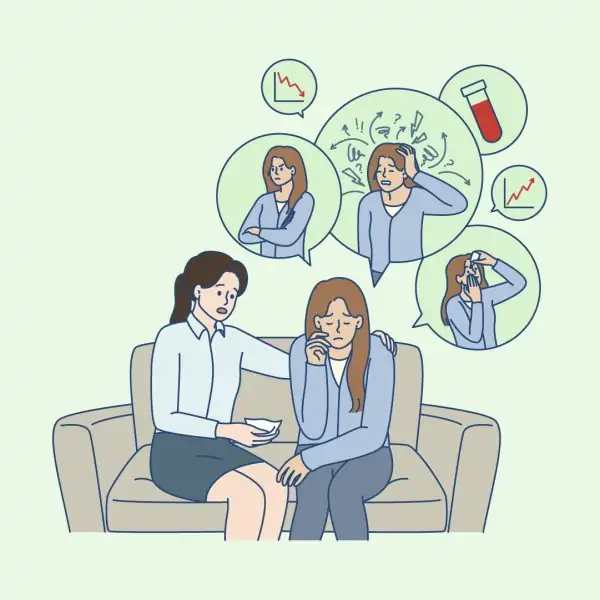
Our subject showed a number of signs consistent with poor blood-sugar handling and insulin resistance:
- Mood swings
- Blurry vision
- Poor cognitive function
- Fatty liver (diagnosis)
- Elevated insulin (lab)
- Low carbon dioxide (lab)
In other words, blood sugar was an important piece of this case.
(NOTE: Want to learn more about the relationship between thyroid function and blood sugar? Take a look at our article on “If Sugar Isn’t the Problem… What Is? The Hidden Link Between Thyroid Function and Blood Sugar“.)
Thyroid-Stress Activator #2: Estrogen Dominance
Next comes estrogen.
Estrogen can also influence the body’s stress response.
And several of her symptoms and labs indicated that estrogen could be involved.
These included:
- Heavy periods
- Edema
- Autoimmune thyroid dysfunction
- Pelvic inflammation (diagnosis)
- Elevated estradiol (lab)
- Elevated prolactin (lab)
- Elevated luteinizing hormone (lab)

This is why we couldn’t look at her thyroid labs in isolation.
Hormones don’t operate independently.
Changes in one part of the system can influence what is happening elsewhere.
And in this case, estrogen balance became another important piece of the puzzle.
This relationship between estrogen, stress, and thyroid function is one reason we look beyond thyroid labs alone.

Thyroid-Stress Activator #3: Excess Serotonin
Next came serotonin.
There’s an important distinction here.
Serotonin wasn’t measured.
So, we can’t say with certainty that her serotonin levels were elevated.
However, her estrogen, prolactin, PTH, symptoms, and digestive history suggested elevated serotonin signaling as another possible factor.
This relationship is part of what we’ve described as the Thyroid-Estrogen-Prolactin Cycle.
We had already verified elevated estrogen and prolactin.
Her labs also showed elevated parathyroid hormone (PTH).
And she showed a number of other symptoms and conditions that made serotonin signaling worth investigating:
- Food sensitivities
- Skin rashes
- Itching
- Irritable bowel syndrome (diagnosed)
- Pelvic inflammation (diagnosed)
- Elevated estrogen, prolactin, and parathyroid hormone (labs)
So, while serotonin wasn’t directly measured, there was enough evidence to keep it on our radar.
Thyroid-Stress Activator #4: Excess Endotoxin
Last, but not least, we have endotoxin.
Endotoxin is produced by certain bacteria in the intestines.
Normally, your digestive system works hard to maintain a healthy intestinal environment and keep these bacterial byproducts in check.
But thyroid problems can change that equation.
Research has explored associations between thyroid function and digestive changes, including small intestinal bacterial overgrowth, or SIBO.
And it just so happens that our subject had also been diagnosed with SIBO.
Because of this, intestinal bacterial byproducts such as endotoxin became another possible contributor we needed to consider.
So now we had the bigger picture.
Blood-sugar problems.
Estrogen imbalance.
Possible excess serotonin signaling.
SIBO and potential endotoxin exposure.
All four thyroid-stress activators were potentially in play.
Hypothyroidism and Stress: 5 Ways to Support a Healthier Stress Response
As you can see, there was a lot going on with this case study subject.
She showed signs consistent with the Thyroid-Adrenal Stress Cycle, with all four primary thyroid-stress activators potentially contributing to the bigger picture.
Plus, she had insulin resistance and significant liver-related concerns.
Two things were for certain…
- This wasn’t going to be a quick and easy recovery.
- With so many complications, it was going to require an individualized approach and some experimentation to determine which strategies worked best for her.
But here’s a good place to start…
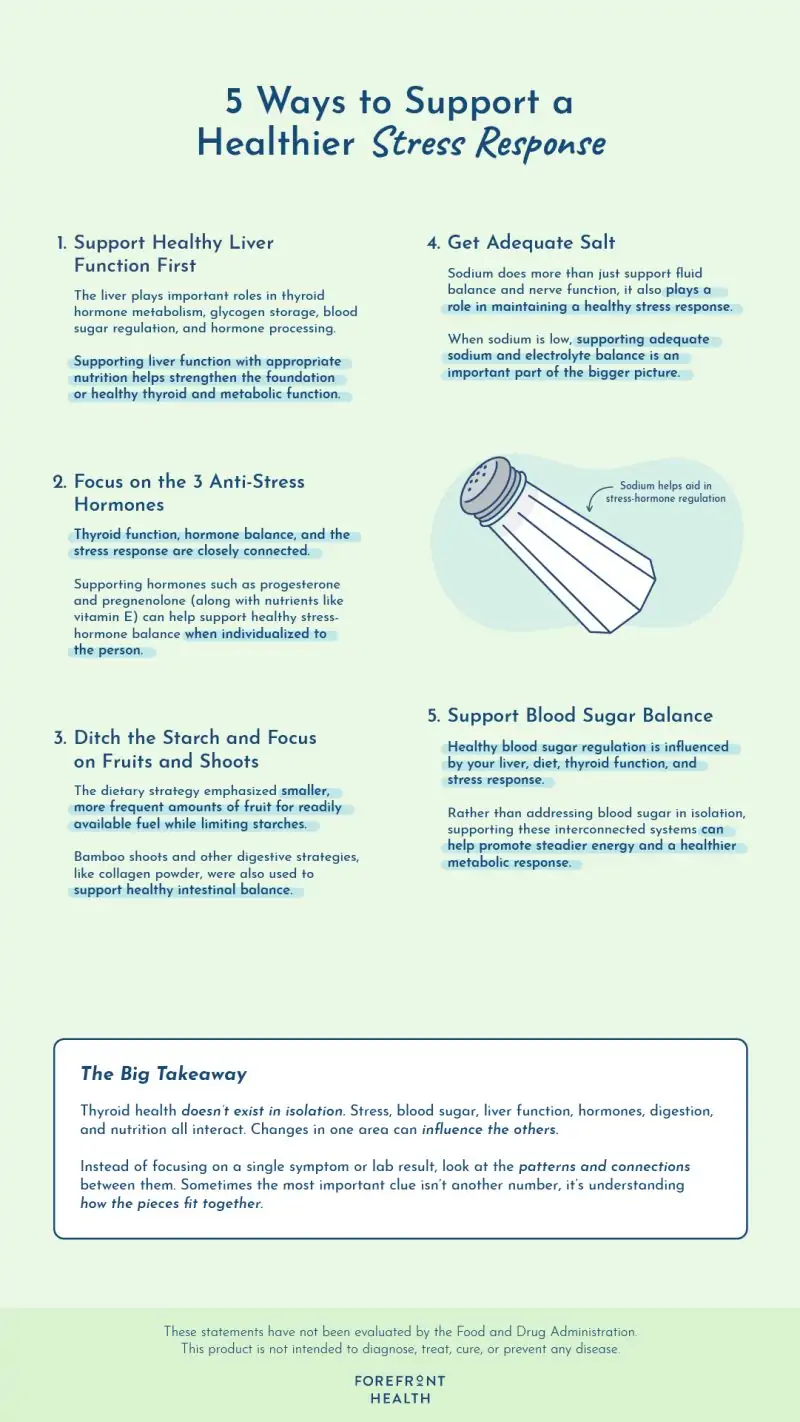
1. Support Healthy Liver Function First
Supporting healthy liver function was made an early priority because thyroid and liver function are closely connected.
That’s something many people overlook.
Your liver isn’t just a “detox” organ.
It also plays important roles in thyroid hormone metabolism, storing glycogen, maintaining blood sugar, and processing hormones.
So, liver support became an important first step in this case.
Some of the nutritional and dietary factors considered included:
- Increasing calcium intake
- Increasing vitamins D and K
- Coffee, to toleration
- Collagen
- Taurine
- Vitamins B1 (thiamine), B2 (riboflavin), and B7 (biotin)
- Appropriate thyroid support
For example, taurine plays important roles in healthy liver and metabolic function.
Collagen provides amino acids such as glycine that can also help support healthy liver function.
And vitamins D, K, and the B vitamins provide additional nutritional support for many of the metabolic processes we’re trying to support.
The goal here wasn’t to chase one symptom.
It was to begin supporting one of the central organs involved in the bigger thyroid and metabolic picture.
2. Focus on the 3 Anti-Stress Hormones
Next, we looked at hormonal support.
Because thyroid function and the stress response are closely connected, supporting healthy stress hormone levels was an important part of the overall strategy.
But there’s an important point here.
When someone has a complicated health history and signs of an elevated stress response, thyroid support needs to be individualized.
More isn’t automatically better.
Tolerance, symptoms, labs, and the person’s broader health picture all matter.
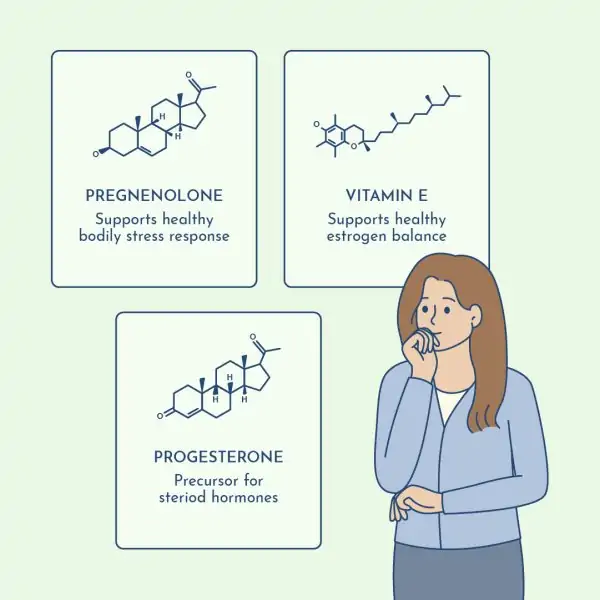
The first hormone we considered was progesterone.
The case also considered progesterone and estrogen balance, and their relationship with the body’s stress response.
In this case, individualized support was recommended.
Vitamin E was also considered, as research has examined its role in supporting healthy estrogen balance.
And finally, we considered pregnenolone.
Pregnenolone is a precursor used by the body to make other steroid hormones and can play a role in supporting healthy stress-hormone balance.
Again, the important point isn’t to blindly add hormones or supplements.
It’s to understand the pattern first.
In this case, thyroid function, estrogen balance, and the body’s stress response all needed to be considered together.

3. Ditch the Starch and Focus on Fruits and Shoots
Diet was another important part of the strategy.
The dietary approach emphasized limiting starches to support steadier blood sugar while also reducing factors that may contribute to endotoxin exposure.
Instead of relying heavily on starch for carbohydrates, the strategy focused more on fruit.
Why?
Fruit provides carbohydrates that can help provide readily available fuel while allowing us to adjust the amount and frequency based on the person’s blood-sugar response.
And with insulin resistance already present, we didn’t want to simply pile on large amounts of carbohydrates at once.
Instead, the strategy emphasized smaller, more frequent amounts of fruit, often combined with collagen protein.
The goal was to provide a steadier supply of fuel without creating unnecessarily large swings in blood sugar.
Digestive health mattered too.
Because SIBO and endotoxin were concerns in this case, foods such as bamboo shoots and other strategies designed to support healthy intestinal balance and elimination were also considered.
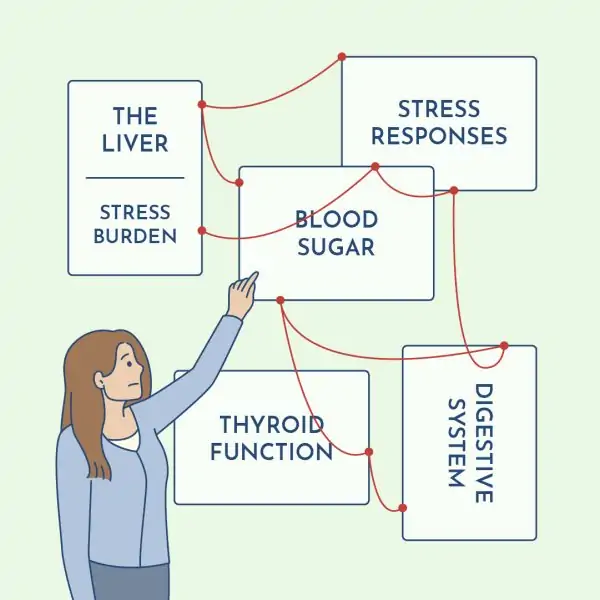
Again, everything connects.
Blood sugar affects the stress response.
The liver helps regulate blood sugar.
The digestive system can influence the body’s inflammatory and stress burden.
And thyroid function interacts with all of them.
4. Get More Salt
Our subject’s labs also showed low sodium.
That mattered.
Sodium isn’t just important for fluid balance and nerve function. Adequate sodium also plays an important role in maintaining a healthy stress response and supporting normal stress-hormone regulation.
That’s especially important in a case like this, where stress was already a major concern.
So, rather than ignoring the low sodium finding, maintaining adequate sodium and electrolyte balance became another important part of the strategy.
5. Support Blood Sugar Balance
Finally, we needed to address blood sugar.
But instead of treating it as an isolated problem, we looked at everything surrounding it.
Liver function.
Diet.
The stress response.
Thyroid function.
All of these can influence blood sugar handling.
That’s why, for many people, supporting healthy liver function becomes an important starting point.
Niacinamide and other targeted nutritional interventions were also considered to help support healthy blood-sugar regulation.
But as with everything in a complicated case like this, the strategy needs to fit the individual.
Thyroid Health Is Interconnected
As you can see, this turned out to be a much more complicated case study than simply looking at a TSH result and calling it a day.
But by using the tools and resources we have at our disposal, including diet and nutrition logs, temperature and pulse logs, labs, symptoms, and health history, we can begin to make sense of the bigger picture.
And there’s one more important lesson here.
The more stress we’re under, the greater the demands placed on the body, and the more thyroid support may be needed to help meet those demands.
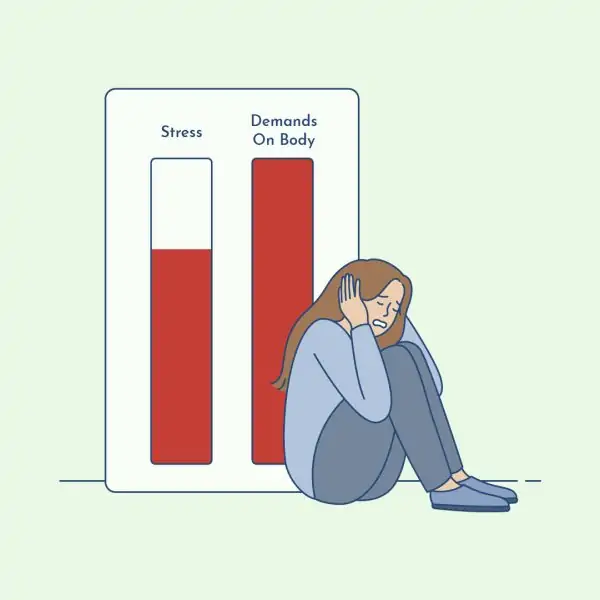
That’s why chronic stress and thyroid function shouldn’t be viewed in isolation.
The thyroid is part of a much larger metabolic system.
When stress increases, blood-sugar regulation can become more challenging.
When liver function suffers, important metabolic processes can become more difficult.
When hormonal and digestive problems enter the picture, the situation can become even more complicated.
That’s exactly what happened in this case.
Could earlier recognition and appropriate management of her thyroid and broader health concerns have helped address some of these factors before they became more difficult to manage?
It’s certainly something worth considering.
Because the further these problems progress and the more complications that develop, the more complicated the road back can become.
And that’s the bigger lesson from this case study.
Understanding the connection between hypothyroidism and stress means looking beyond either problem by itself.
Don’t just look at one symptom.
Don’t just look at one lab.
Look at the patterns.
Look at thyroid function, blood sugar, liver function, hormones, digestion, nutrition, and the body’s stress response together.
Because sometimes the clue you’ve been missing isn’t hidden in another isolated lab result.
It’s hidden in the connections between them.

KEY IDEA:
What happens when stress and thyroid problems collide?
In this extreme case study, one woman reported an astonishing 69 thyroid symptoms. Looking beyond her thyroid labs revealed four potential “thyroid-stress activators”: poor blood sugar regulation, estrogen imbalance, excess serotonin signaling, and endotoxin.
The bigger lesson? Thyroid function and the body’s stress response are closely connected, and problems with liver function, blood sugar, hormones, and digestion can add even more stress to the system.
Discover how these hidden connections may work against healthy thyroid function, plus five strategies used to support a healthier stress response and better thyroid health.